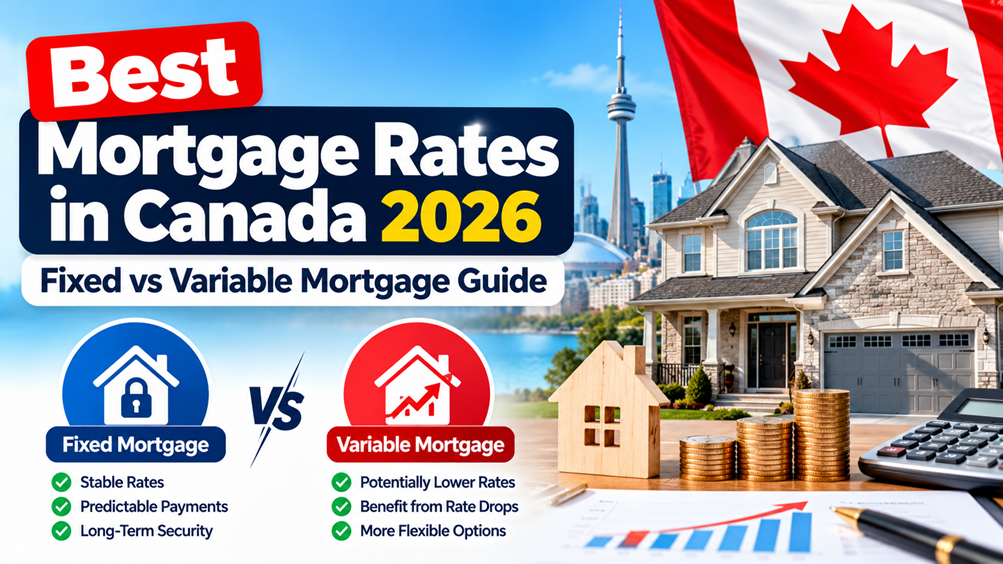
Best Mortgage Rates in Canada 2026 – Fixed vs Variable Mortgage Guide
Finding the best mortgage rates in Canada in 2026 is an important financial decision for homebuyers, property investors, and homeowners approaching mortgage renewal. Even a small difference in mortgage interest rates can affect monthly payments and the total cost of borrowing over several years.
However, choosing a mortgage involves more than finding the lowest advertised rate. Borrowers must also consider the mortgage term, repayment flexibility, prepayment privileges, penalties, lender conditions, and their long-term financial goals.
In Canada, two of the most common financing options are fixed-rate mortgages and variable-rate mortgages. While fixed mortgages provide predictable interest rates during the term, variable mortgages respond to changes in the lender’s prime rate.
This detailed guide explains how Canadian mortgage rates work, compares fixed and variable mortgages, explores major mortgage lenders, and provides practical strategies for finding competitive home financing in 2026.
1. Understanding Mortgage Rates in Canada
A mortgage rate is the interest rate charged by a lender on money borrowed to purchase or refinance a property.
Canadian mortgage rates depend on several economic and borrower-specific factors. These include monetary policy, bond-market conditions, lender funding costs, creditworthiness, mortgage insurance, and loan characteristics.
Although mortgage advertisements often emphasize the interest rate, borrowers should also examine the complete mortgage agreement.
For example, a mortgage offering a slightly higher rate may include better prepayment privileges or lower penalties for breaking the contract early.
Therefore, comparing mortgage rates in Canada requires evaluating both borrowing costs and contractual flexibility.
What Influences Canadian Mortgage Rates?
Several factors influence the rates available to borrowers.
Bank of Canada Monetary Policy: Changes in the central bank’s policy rate generally influence lenders’ prime rates and variable-rate mortgage pricing.
Government Bond Yields: Fixed mortgage rates are influenced by bond yields, lender funding costs, and market expectations.
Credit Profile: Borrowers with strong credit histories may qualify for more competitive mortgage offers.
Down Payment: The size of a down payment affects mortgage insurance requirements and the lender’s assessment of risk.
Mortgage Type: Insured, insurable, and uninsured mortgages may be priced differently.
Mortgage Term: A three-year mortgage may have a different rate from a five-year mortgage.
Property and Occupancy: Owner-occupied homes, rental properties, and other property types may have different lending requirements.
Consequently, the lowest advertised mortgage rate may not be available to every applicant.
2. Fixed vs Variable Mortgage Rates in Canada
The choice between a fixed and variable mortgage is one of the most important decisions Canadian borrowers face.
Both options have advantages and disadvantages. However, the best choice depends on household finances, interest-rate expectations, and tolerance for payment uncertainty.
Fixed-Rate Mortgages in Canada
A fixed-rate mortgage in Canada maintains the same contractual interest rate throughout the mortgage term.
For example, a borrower choosing a five-year fixed mortgage generally pays the same interest rate for those five years, even if market rates change.
As a result, fixed mortgages provide greater predictability.
Advantages of Fixed Mortgage Rates
- The interest rate remains unchanged during the term.
- Payments are generally predictable.
- Household budgeting becomes easier.
- Borrowers are protected from rate increases during the term.
- Fixed rates may suit buyers who prioritize financial stability.
Disadvantages of Fixed Mortgage Rates
- Borrowers may not benefit immediately when market interest rates decline.
- Some fixed mortgages carry substantial penalties for early termination.
- Refinancing or switching before maturity may be expensive.
- A fixed rate may initially be higher than a comparable variable rate.
Therefore, fixed mortgages may be attractive to homeowners who prefer predictable payments over potential interest savings.
Variable-Rate Mortgages in Canada
A variable-rate mortgage in Canada has an interest rate that can change during the mortgage term.
Variable mortgage pricing is commonly expressed relative to the lender’s prime rate.
For example:
Prime rate − 0.50%
If the lender’s prime rate changes, the mortgage’s interest rate generally changes as well.
However, variable mortgage products do not all operate identically.
Some have adjustable payments that change with interest rates. Others have fixed scheduled payments, where changes in interest rates alter the portion going toward principal and interest.
Depending on the mortgage contract, payment adjustments may be required when certain thresholds are reached.
Advantages of Variable Mortgage Rates
- Borrowers may benefit when interest rates decline.
- Some variable products offer more flexible early-exit penalties.
- Variable rates may sometimes begin below comparable fixed rates.
- Borrowers may have opportunities to convert to fixed-rate products, subject to lender conditions.
Disadvantages of Variable Mortgage Rates
- Interest rates can increase during the term.
- Borrowing costs may become less predictable.
- Adjustable payments may rise when rates increase.
- Fixed-payment variable mortgages may experience slower principal repayment when interest costs rise.
Consequently, variable mortgages may suit borrowers who can tolerate interest-rate fluctuations and understand the specific terms of their loan.
3. Fixed vs Variable Mortgage Comparison
| Feature | Fixed-Rate Mortgage | Variable-Rate Mortgage |
|---|---|---|
| Interest rate | Fixed for the term | Changes with lender prime rate |
| Predictability | Higher | Lower |
| Benefits from falling rates | Not automatically | Generally yes |
| Exposure to rising rates | Protected during term | Exposed |
| Early termination penalty | May be substantial | Often based on three months’ interest, subject to contract |
| Budget planning | Usually easier | Depends on payment structure |
| Suitable for | Stability-focused borrowers | Borrowers comfortable with rate risk |
Important: Neither fixed nor variable mortgages are universally cheaper. The better financial outcome depends on the actual rates, timing of rate changes, contract provisions, and length of time the mortgage is held.
4. Best Mortgage Rates in Canada 2026 – How to Compare Current Offers
Borrowers searching for the lowest mortgage rates in Canada today should distinguish between advertised rates and personalized lender offers.
Mortgage rates can change frequently. Additionally, advertised rates may apply only to particular borrowers, property types, or insured mortgages.
For an accurate comparison, request quotes for the same:
- Mortgage amount and amortization period.
- Fixed or variable product.
- Mortgage term.
- Property occupancy and location.
- Down payment and insurance status.
- Prepayment privileges.
- Mortgage portability and refinancing conditions.
Mortgage Rate Comparison Worksheet
| Mortgage Product | Rate to Request | Key Detail to Compare |
|---|---|---|
| 3-year fixed mortgage | Current personalized quote | Rate stability and renewal timing |
| 5-year fixed mortgage | Current personalized quote | Total interest and break penalties |
| 5-year variable mortgage | Current personalized quote | Prime-rate discount and payment structure |
| Insured mortgage | Eligible insured rate | Mortgage insurance premium |
| Uninsured mortgage | Eligible uninsured rate | Loan-to-value and lender conditions |
| Mortgage renewal | Renewal quote | Switching costs and available alternatives |
| Mortgage refinance | Refinance quote | Equity requirements and total borrowing costs |
Rather than relying on a single comparison website, borrowers should review offers from banks, credit unions, and licensed mortgage professionals.
2026 rate note: Exact live mortgage rates are not included here because they change and depend on borrower eligibility. Obtain dated quotes directly from lenders before making a decision.
5. Major Mortgage Lenders in Canada
Canada has a competitive mortgage market involving major banks, credit unions, monoline lenders, and mortgage brokers.
The following established institutions are commonly considered by Canadian borrowers.
RBC Royal Bank
RBC offers mortgage products that include fixed and variable interest-rate options, subject to eligibility.
Borrowers can explore mortgage pre-approval, renewal, and refinancing options.
Additionally, RBC may appeal to customers who prefer managing multiple banking products through one institution.
However, borrowers should compare RBC’s actual mortgage offer with competing lenders rather than assuming a major bank provides the lowest rate.
TD Canada Trust
TD provides residential mortgage financing and related banking services.
Depending on the product, borrowers may review fixed-rate and variable-rate mortgage options.
Furthermore, existing customers may find it convenient to discuss mortgage renewals and other borrowing needs through their banking relationship.
Nevertheless, convenience should be evaluated alongside interest rates and contract conditions.
Scotiabank
Scotiabank offers mortgage products for eligible Canadian homebuyers and homeowners.
Borrowers can investigate available mortgage terms, payment options, and renewal conditions.
Before signing, review the lender’s prepayment privileges and early termination provisions.
BMO
BMO provides residential mortgage solutions, including fixed and variable options.
Homebuyers may consider mortgage pre-approval and financing products that align with their purchase plans.
However, the final rate and terms depend on lender underwriting and product eligibility.
CIBC
CIBC offers mortgage financing, refinancing, and renewal services.
Borrowers can compare available mortgage terms and discuss their financial circumstances with a lending representative.
Additionally, homeowners approaching renewal should request a competitive quote before automatically accepting an initial renewal offer.
National Bank of Canada
National Bank offers mortgage financing and related financial services.
Its products may be worth considering for borrowers comparing established financial institutions.
As with other lenders, the interest rate is only one component of the total mortgage agreement.
Credit Unions and Alternative Mortgage Lenders
Canadian credit unions and non-bank mortgage lenders may also provide competitive options.
However, product availability, membership requirements, underwriting criteria, and consumer protections can vary.
Therefore, borrowers should confirm the lender’s regulatory status and understand the mortgage contract before proceeding.
6. Three-Year vs Five-Year Fixed Mortgage in Canada
Canadian homebuyers frequently compare 3-year fixed mortgage rates and 5-year fixed mortgage rates.
A three-year mortgage offers a shorter period before renewal.
Meanwhile, a five-year mortgage provides interest-rate certainty for a longer term.
Three-Year Fixed Mortgage
A three-year fixed mortgage may appeal to borrowers who prefer a shorter commitment.
For example, homeowners expecting major financial changes within several years may value the earlier renewal date.
However, the rate available at renewal is unknown.
Five-Year Fixed Mortgage
A five-year fixed mortgage offers a longer period of predictable interest rates.
Consequently, borrowers concerned about future rate increases may prefer this structure.
Nevertheless, breaking a five-year fixed mortgage early can result in significant penalties, depending on the lender and contract.
Which Mortgage Term Is Better?
The answer depends on the difference between current quotes, future refinancing plans, and financial stability.
Borrowers should compare the total expected borrowing costs rather than selecting a term solely because its advertised rate appears lower.
7. Mortgage Payment Examples – How Interest Rates Affect Costs
Even modest interest-rate differences can materially change mortgage payments.
Consider a hypothetical Canadian mortgage with:
- Mortgage principal: $500,000
- Amortization: 25 years
- Payment frequency: Monthly
- Interest-rate scenarios: 3.5%, 4.0%, 4.5%, and 5.0%
The following estimates use standard Canadian mortgage calculations with nominal annual rates compounded semi-annually.
| Illustrative Rate | Approximate Monthly Payment |
|---|---|
| 3.5% | $2,496 |
| 4.0% | $2,631 |
| 4.5% | $2,767 |
| 5.0% | $2,908 |
These figures are illustrative, not actual lender quotes. They exclude property taxes, insurance, lender fees, and other homeownership expenses.
The example demonstrates why borrowers should compare multiple mortgage offers carefully.
Furthermore, a lower monthly payment does not necessarily mean the mortgage has the lowest total cost if fees, penalties, or amortization periods differ.
8. Best Mortgage Rates for First-Time Home Buyers in Canada
Buying a first home can be challenging, particularly in expensive housing markets.
However, first-time buyers may have access to mortgage insurance arrangements and government programs, depending on eligibility.
Understand Down Payment Requirements
Canadian down payment rules depend on the property’s purchase price and applicable mortgage regulations.
For many eligible owner-occupied purchases, the minimum down payment is:
- 5% on the first $500,000.
- 10% on the portion above $500,000 up to the applicable insured-mortgage price ceiling.
- Generally 20% for properties that do not qualify for high-ratio mortgage insurance.
A down payment below 20% commonly requires mortgage default insurance, subject to eligibility.
Get Mortgage Pre-Approval
A mortgage pre-approval can help buyers understand their potential borrowing capacity.
However, pre-approval is not a guarantee of final financing.
The lender may still need to assess the property, income documentation, credit profile, and other conditions.
Explore First-Time Home Buyer Programs
Eligible Canadians may benefit from programs such as:
First Home Savings Account (FHSA): A registered account designed to help eligible first-time homebuyers save for a qualifying home purchase.
Home Buyers’ Plan (HBP): An eligible withdrawal program involving registered retirement savings.
Home Buyers’ Amount: A federal non-refundable tax credit for eligible homebuyers.
Provincial Programs: Certain provinces offer land transfer tax rebates or other assistance for qualifying buyers.
Since program rules and limits can change, verify current eligibility with the Canada Revenue Agency and relevant provincial authorities.
9. Mortgage Rates in Ontario
Ontario is one of Canada’s largest housing markets.
Borrowers searching for best mortgage rates in Ontario should compare products from banks, credit unions, and other eligible lenders.
Mortgage Rates in Toronto
Toronto buyers often face significant borrowing requirements because of property prices.
Consequently, affordability assessments, down payment size, and household income can be particularly important.
Mortgage Rates in Ottawa
Ottawa homebuyers should compare mortgage terms and consider future renewal costs.
Additionally, first-time buyers should investigate applicable provincial and federal programs.
Mortgage Rates in Mississauga and Brampton
Buyers in Mississauga and Brampton should compare financing options using their actual purchase price and down payment.
Although these cities share Ontario’s regulatory framework, borrower circumstances can produce different mortgage offers.
10. Mortgage Rates in British Columbia
British Columbia includes expensive housing markets such as Vancouver and surrounding municipalities.
Therefore, buyers should carefully evaluate mortgage affordability and the long-term cost of borrowing.
Mortgage Rates in Vancouver
Vancouver homebuyers may require substantial down payments depending on property values and mortgage insurance eligibility.
Furthermore, borrowers should account for property taxes, strata fees where applicable, and other ownership costs.
Mortgage Rates in Surrey and Burnaby
Buyers in Surrey and Burnaby should compare lender offers and ensure the mortgage payment fits comfortably within their household budget.
A mortgage with a lower initial rate may not be ideal if its terms limit future financial flexibility.
11. Mortgage Rates in Alberta
Alberta’s major housing markets include Calgary and Edmonton.
Borrowers looking for mortgage rates in Alberta can compare financing options across participating lenders.
Mortgage Rates in Calgary
Calgary homebuyers should examine fixed and variable mortgage options based on current financial circumstances.
Mortgage Rates in Edmonton
Similarly, Edmonton buyers should evaluate prepayment options, lender conditions, and renewal flexibility.
In both cities, mortgage affordability should account for property taxes, maintenance, utilities, and other ownership expenses.
12. Mortgage Rates in Quebec
Quebec homebuyers can compare mortgages offered by major banks, credit unions, and other participating lenders.
Montreal and Quebec City buyers should review both mortgage rates and province-specific transaction requirements.
Furthermore, borrowers should understand legal and administrative costs associated with purchasing property.
As a result, comparing the complete financing arrangement is more useful than focusing on interest rates alone.
13. Mortgage Renewal Rates in Canada 2026
Many Canadian homeowners face mortgage renewals in 2026.
When a mortgage term expires, borrowers generally need to renew their mortgage, repay the balance, or arrange alternative financing.
However, the rate offered at renewal may differ substantially from the rate on the expiring contract.
How to Get a Better Mortgage Renewal Rate
Start Early: Review your renewal options several months before the mortgage maturity date.
Compare Lenders: Request offers from your existing lender and competing institutions.
Review Your Mortgage Balance: Consider whether making permitted prepayments could reduce future interest costs.
Understand Switching Requirements: Changing lenders may involve documentation, legal costs, or qualification requirements.
Negotiate Carefully: Ask whether your current lender can improve its renewal offer.
Importantly, mortgage renewal rules differ by product and borrower circumstances.
Therefore, verify whether a lender switch requires a new affordability assessment and what fees may apply.
14. Mortgage Refinancing in Canada
Mortgage refinancing in Canada allows eligible homeowners to replace an existing mortgage with a new financing arrangement.
Some borrowers refinance to consolidate debt, access home equity, or change mortgage terms.
However, refinancing is not automatically beneficial.
Common Reasons to Refinance
- Consolidating higher-interest debt.
- Financing eligible home improvements.
- Changing mortgage terms.
- Accessing home equity.
- Adjusting the repayment structure.
Costs of Mortgage Refinancing
Refinancing may involve mortgage discharge fees, legal expenses, appraisal costs, and prepayment penalties.
Consequently, homeowners should compare the expected financial benefit against all refinancing costs.
For example, reducing an interest rate may not save money if the penalty for breaking the existing mortgage is greater than the anticipated interest savings.
15. Mortgage Stress Test in Canada
Mortgage qualification in Canada involves affordability assessments designed to evaluate whether borrowers can manage their payments.
For federally regulated lenders, qualifying rules generally require borrowers to demonstrate affordability at a rate higher than their actual contractual mortgage rate.
The applicable qualifying rate depends on current regulations and the mortgage transaction.
Furthermore, borrowers must satisfy lender requirements concerning income, debt obligations, credit history, and property eligibility.
Why the Stress Test Matters
A borrower may qualify for a smaller mortgage than expected, even when the advertised interest rate appears affordable.
Therefore, understanding the stress test before shopping for a home can prevent unrealistic budgeting.
16. Mortgage Brokers vs Banks in Canada
Borrowers frequently ask whether a mortgage broker in Canada can obtain a better rate than a bank.
Both options can be useful.
Working Directly With a Bank
A bank may offer convenient access to mortgage services alongside existing financial accounts.
However, its representatives generally focus on products available through that institution.
Working With a Mortgage Broker
A mortgage broker may help borrowers compare products from participating lenders.
Additionally, brokers may assist with understanding lender eligibility and different mortgage structures.
Nevertheless, brokers do not necessarily access every lender or guarantee the lowest available rate.
Borrowers should ask about lender relationships, compensation, licensing, and any applicable fees.
17. How to Find the Lowest Mortgage Rates in Canada
Obtaining a competitive mortgage requires preparation.
Improve Your Credit Profile
Review your credit reports, make payments on time, and avoid unnecessary new debt.
A stronger credit profile may improve access to financing.
Compare Multiple Mortgage Terms
Do not assume that a five-year fixed mortgage is always the best option.
Instead, compare three-year fixed, five-year fixed, and variable products.
Understand Insured and Uninsured Pricing
Mortgage insurance status can affect the rates offered.
However, borrowers should compare the total cost, including any insurance premium, rather than considering the rate in isolation.
Negotiate With Lenders
Request competitive offers and ask whether the lender can improve the quoted rate.
Evaluate Mortgage Penalties
Before accepting an offer, understand how early repayment and mortgage termination penalties are calculated.
Review Prepayment Privileges
Some mortgages allow borrowers to increase regular payments or make lump-sum prepayments within specified limits.
These features may reduce interest costs over time.
Avoid Choosing a Mortgage Based Only on Rate
A low advertised interest rate may come with restrictions that make the mortgage less suitable.
Therefore, always evaluate the complete agreement.
18. Common Mortgage Mistakes Canadian Homebuyers Should Avoid
Buying a home involves substantial financial commitments.
Unfortunately, several common mistakes can increase borrowing costs.
Ignoring Closing Costs: Legal fees, land transfer taxes, inspections, and other expenses can affect affordability.
Borrowing the Maximum Available: Qualification limits do not necessarily reflect a comfortable household budget.
Overlooking Penalties: Breaking a mortgage early can be expensive.
Not Comparing Renewal Offers: Automatically accepting the first renewal quote may mean missing a better option.
Confusing Mortgage Term and Amortization: The term determines how long the contract conditions apply, while amortization describes the planned repayment period.
Assuming Variable Rates Always Save Money: Variable rates can increase and may result in higher borrowing costs.
Ignoring Future Financial Changes: Employment changes, family expenses, and other commitments can affect repayment capacity.
Consequently, borrowers should plan for both current affordability and potential future challenges.
19. Frequently Asked Questions About Mortgage Rates in Canada
What are the best mortgage rates in Canada in 2026?
The best available rate depends on the lender, mortgage type, term, insurance status, and borrower qualifications. Compare current personalized quotes from multiple providers.
Is a fixed or variable mortgage better in Canada?
Fixed mortgages offer predictable interest rates, while variable mortgages may benefit from falling rates but expose borrowers to rate increases. The better option depends on risk tolerance and financial circumstances.
Are mortgage rates expected to fall in Canada?
Future mortgage rates depend on inflation, monetary policy, bond yields, and economic conditions. Forecasts are uncertain, so borrowers should avoid relying on guaranteed rate predictions.
Is a three-year or five-year fixed mortgage better?
A three-year fixed mortgage provides a shorter commitment, while a five-year fixed mortgage provides longer rate certainty. Compare actual offers, penalties, and future plans.
Can I negotiate mortgage rates with Canadian banks?
Yes. Borrowers can ask lenders whether more competitive rates or terms are available, although approval and pricing remain subject to lender policies.
What credit score is needed for a mortgage in Canada?
There is no single universal credit-score requirement for all mortgage lenders. Eligibility depends on the lender, loan type, income, debt obligations, and other underwriting factors.
Can newcomers get a mortgage in Canada?
Eligible newcomers may qualify for mortgage financing, depending on residency, income, credit, down payment, property eligibility, and lender requirements.
Can I switch mortgage lenders at renewal?
Often, yes. However, switching may involve qualification requirements, documentation, and fees. The rules depend on the mortgage and lender.
How much down payment do I need in Canada?
Minimum down payment requirements depend on the purchase price and mortgage insurance eligibility. Some eligible purchases permit down payments below 20%, while others require at least 20%.
Does the Bank of Canada directly set fixed mortgage rates?
No. The Bank of Canada sets its policy interest rate, which influences broader borrowing conditions. Fixed mortgage rates are also influenced by bond markets and lender funding costs.
20. Final Thoughts: Choosing the Best Mortgage in Canada
Finding the best mortgage rates in Canada in 2026 requires comparing more than advertised interest rates.
Homebuyers and homeowners should evaluate fixed and variable mortgages, lender conditions, penalties, repayment flexibility, and long-term financial objectives.
While fixed mortgages may appeal to borrowers who prioritize predictable payments, variable mortgages may suit individuals who can manage changing borrowing costs.
Furthermore, comparing multiple mortgage lenders and reviewing financing options before renewal can help Canadians make better borrowing decisions.
Whether you are purchasing your first home in Toronto, refinancing a property in Vancouver, renewing a mortgage in Calgary, or exploring financing in Montreal, informed mortgage planning can support long-term financial stability.
Disclaimer: This article is for general educational purposes only and does not constitute personalized mortgage, legal, tax, or financial advice. Mortgage rates, regulations, and eligibility requirements may change. Consult qualified mortgage professionals and verify current information with lenders and Canadian regulatory authorities before making financial decisions.