Top 15 Skills Required for AI and ML Jobs in India in 2026
Artificial Intelligence (AI) and Machine Learning (ML) are changing how businesses develop software, analyse data, and automate operations. As a result, companies across India’s IT services, banking, healthcare, e-commerce, and manufacturing sectors are exploring opportunities to implement intelligent technologies.
However, building a successful career in AI requires more than understanding basic algorithms. Employers look for professionals who can develop machine learning models, process large datasets, integrate AI applications, and deploy reliable solutions.
Therefore, understanding the skills required for AI and ML jobs in India is essential for fresh graduates, software developers, data professionals, and experienced engineers planning to enter this field.
Moreover, technologies such as Generative AI, Large Language Models (LLMs), Deep Learning, and MLOps are expanding the technical capabilities expected in specialised AI roles.
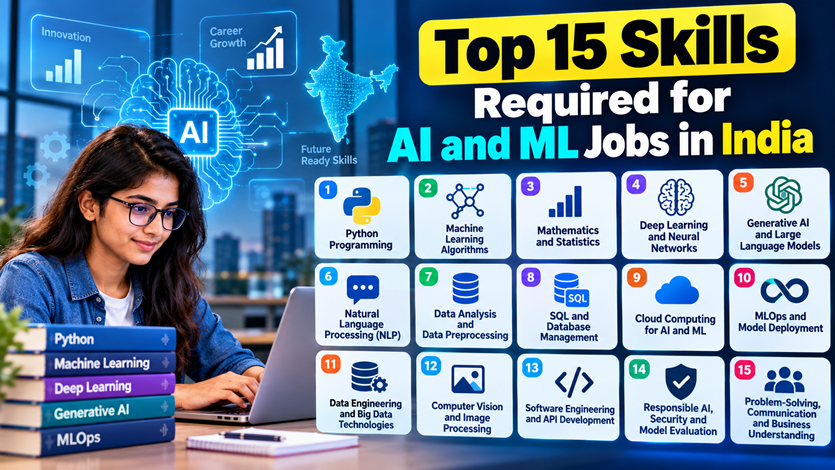
In this article, we explore the top 15 technical skills that can help candidates prepare for AI and Machine Learning career opportunities in India in 2026.
1. Python Programming
Python is one of the most important programming languages for Artificial Intelligence and Machine Learning development. Therefore, candidates should begin by building a strong foundation in Python.
AI Engineers use Python to process data, develop algorithms, train models, and integrate intelligent applications.
Additionally, Python offers libraries and frameworks that simplify complex machine learning tasks.
Important Python skills include:
- Variables, functions, loops, and data structures.
- Object-oriented programming.
- File handling and exception handling.
- NumPy and Pandas.
- API development and integration.
- Writing reusable and maintainable code.
Furthermore, knowledge of Python testing and debugging helps engineers develop reliable AI applications.
Career Relevance: AI Engineer, Machine Learning Engineer, Python AI Developer, and Data Scientist.
2. Machine Learning Algorithms
Machine Learning algorithms form the foundation of intelligent predictive systems. Consequently, candidates should understand how algorithms learn patterns from data and generate predictions.
Employers may assess knowledge of supervised learning, unsupervised learning, and model evaluation during technical interviews.
Important topics include:
- Linear and Logistic Regression.
- Decision Trees and Random Forests.
- Support Vector Machines.
- K-Means Clustering.
- Gradient Boosting.
- Feature Engineering.
- Model Evaluation and Cross-Validation.
Moreover, understanding overfitting, underfitting, and regularisation is essential for building reliable models.
Instead of memorising algorithms, candidates should practise selecting suitable methods for different business problems.
Career Relevance: Machine Learning Engineer, Data Scientist, AI Developer, and Predictive Analytics Engineer.
3. Mathematics and Statistics
Mathematics provides the theoretical foundation for Machine Learning and Deep Learning. Therefore, candidates should develop a practical understanding of mathematical concepts used in model development.
Although advanced research roles may require deeper mathematical expertise, entry-level engineers should understand essential statistical principles.
Important concepts include:
- Linear Algebra.
- Probability and Statistics.
- Calculus fundamentals.
- Optimisation techniques.
- Probability distributions.
- Hypothesis Testing.
- Statistical Model Evaluation.
For example, linear algebra is used extensively in neural networks, while probability helps engineers understand uncertainty and prediction.
Furthermore, statistical knowledge supports better interpretation of machine learning results.
Career Relevance: Data Scientist, Machine Learning Engineer, AI Research Engineer, and Applied Scientist.
4. Deep Learning and Neural Networks
Deep Learning enables AI systems to learn complex patterns from large datasets. As a result, it is widely used in image recognition, language processing, speech technologies, and Generative AI applications.
Candidates interested in advanced AI engineering should understand neural network architectures and training techniques.
Important skills include:
- Artificial Neural Networks (ANN).
- Convolutional Neural Networks (CNN).
- Recurrent Neural Networks (RNN).
- Transformer architectures.
- Activation functions.
- Backpropagation.
- Model training and optimisation.
Additionally, practical experience with TensorFlow or PyTorch can help candidates demonstrate their Deep Learning knowledge.
Career Relevance: Deep Learning Engineer, Computer Vision Engineer, NLP Engineer, and AI Research Engineer.
5. Generative AI and Large Language Models
Generative AI has become an important area of AI application development. Consequently, professionals with knowledge of LLM-based systems can explore specialised engineering opportunities.
Generative AI Engineers build applications capable of generating text, summarising documents, answering questions, and supporting intelligent workflows.
Important technologies include:
- Large Language Models (LLMs).
- Transformer-based models.
- Prompt Engineering.
- Retrieval-Augmented Generation (RAG).
- Embeddings and Vector Databases.
- Model Evaluation.
- AI Application Integration.
Moreover, candidates should understand the limitations of LLMs, including hallucinations, data privacy risks, and unreliable outputs.
For example, building a document-based AI assistant using RAG can demonstrate practical knowledge of modern Generative AI development.
Career Relevance: Generative AI Engineer, LLM Developer, AI Application Engineer, and NLP Engineer.
6. Natural Language Processing (NLP)
Natural Language Processing helps computer systems understand and generate human language. Therefore, NLP is important for applications involving chatbots, text analysis, enterprise search, and automated document processing.
Candidates should understand both traditional NLP methods and modern transformer-based approaches.
Important NLP skills include:
- Text Preprocessing.
- Tokenisation.
- Sentiment Analysis.
- Named Entity Recognition.
- Text Classification.
- Transformer Models.
- Semantic Search.
Additionally, familiarity with Hugging Face and NLP libraries can help candidates develop practical applications.
Career Relevance: NLP Engineer, Conversational AI Developer, Generative AI Engineer, and Language Technology Specialist.
7. Data Analysis and Data Preprocessing
Machine Learning models depend on reliable and relevant datasets. Therefore, data preparation is one of the most important stages of AI development.
Engineers frequently spend time cleaning datasets, handling missing values, identifying outliers, and transforming data into suitable formats.
Important data processing skills include:
- Data Cleaning.
- Exploratory Data Analysis.
- Missing Value Handling.
- Feature Scaling.
- Data Transformation.
- Data Visualisation.
- Dataset Validation.
Moreover, knowledge of Pandas, NumPy, Matplotlib, and other analytical tools supports efficient data processing.
Career Relevance: Data Scientist, Machine Learning Engineer, Data Analyst, and AI Developer.
8. SQL and Database Management
AI applications often depend on data stored in relational databases, cloud platforms, and data warehouses. Consequently, SQL remains an important skill for many AI and Machine Learning positions.
Candidates should understand how to retrieve, filter, combine, and analyse datasets.
Important database skills include:
- SQL Queries.
- Joins and Subqueries.
- Aggregation Functions.
- Database Design Fundamentals.
- Query Optimisation.
- Data Extraction.
- Basic Data Warehousing Concepts.
Furthermore, familiarity with PostgreSQL, MySQL, and cloud-based data platforms can be useful.
Career Relevance: Machine Learning Engineer, Data Scientist, Data Engineer, and Analytics Engineer.
9. Cloud Computing for AI and ML
Cloud computing platforms provide infrastructure for developing, training, and deploying AI applications. As a result, cloud knowledge is valuable for engineers working on production machine learning systems.
Major cloud platforms include Amazon Web Services, Microsoft Azure, and Google Cloud.
Important cloud skills include:
- Cloud Storage and Computing.
- AI and ML Cloud Services.
- Model Deployment.
- API Hosting.
- Cloud Security Fundamentals.
- Infrastructure Monitoring.
- Resource and Cost Management.
Additionally, understanding cloud deployment helps candidates demonstrate that they can move AI applications beyond local development environments.
Career Relevance: Cloud AI Engineer, Machine Learning Engineer, MLOps Engineer, and AI Solutions Engineer.
10. MLOps and Model Deployment
MLOps combines machine learning development with software engineering and operational practices. Therefore, it is important for organisations deploying AI models into production.
MLOps Engineers help automate model deployment, monitoring, testing, and maintenance.
Important MLOps technologies include:
- Docker.
- Kubernetes.
- MLflow.
- CI/CD Pipelines.
- Model Versioning.
- Model Monitoring.
- Automated Testing.
Moreover, understanding model drift, deployment failures, and performance monitoring helps engineers maintain reliable AI systems.
Career Relevance: MLOps Engineer, ML Platform Engineer, Machine Learning Engineer, and AI Infrastructure Engineer.
11. Data Engineering and Big Data Technologies
Large-scale AI applications often require efficient data pipelines and distributed processing systems. Consequently, data engineering skills can be valuable for machine learning professionals.
Engineers working with large datasets should understand how data is collected, transformed, stored, and processed.
Important technologies include:
- Apache Spark.
- ETL and ELT Pipelines.
- Data Warehousing.
- Data Lakes.
- Distributed Data Processing.
- Workflow Orchestration.
- Data Quality Monitoring.
Furthermore, knowledge of data engineering helps AI professionals collaborate effectively with platform and infrastructure teams.
Career Relevance: Data Engineer, ML Data Engineer, Machine Learning Engineer, and Big Data Engineer.
12. Computer Vision and Image Processing
Computer Vision enables AI applications to interpret images and videos. As a result, it is used in manufacturing, healthcare, document processing, and industrial automation.
Professionals interested in visual AI applications should understand image processing and Deep Learning techniques.
Important skills include:
- OpenCV.
- Image Classification.
- Object Detection.
- Image Segmentation.
- Convolutional Neural Networks.
- Image Preprocessing.
- Computer Vision Model Evaluation.
Additionally, practical projects involving object detection or image classification can strengthen a candidate’s technical portfolio.
Career Relevance: Computer Vision Engineer, Deep Learning Engineer, AI Research Engineer, and Image Processing Engineer.
13. Software Engineering and API Development
AI Engineers must often integrate machine learning models into real software applications. Therefore, strong software engineering fundamentals are essential.
Developing an accurate model is only one part of building a complete AI solution.
Engineers should also understand application architecture, testing, APIs, and maintainable code.
Important skills include:
- Data Structures and Algorithms.
- Object-Oriented Programming.
- REST API Development.
- FastAPI and Flask.
- Git and Version Control.
- Unit Testing.
- Software Architecture Fundamentals.
Moreover, knowledge of backend development helps AI professionals build applications that communicate with databases, cloud services, and user interfaces.
Career Relevance: AI Software Engineer, Machine Learning Engineer, Backend AI Developer, and Generative AI Engineer.
14. Responsible AI, Security and Model Evaluation
As AI systems become more widely used, organisations must consider reliability, privacy, security, and responsible deployment.
Consequently, engineers should understand the risks associated with AI models and automated decision-making systems.
Important areas include:
- Model Bias and Fairness.
- Data Privacy.
- Explainable AI.
- AI Application Security.
- Model Accuracy and Reliability.
- LLM Evaluation.
- Responsible AI Practices.
For example, an AI application processing customer information should follow appropriate data protection and access control practices.
Furthermore, engineers should understand how to identify unreliable outputs and evaluate model performance before deployment.
Career Relevance: Responsible AI Engineer, AI Security Specialist, Machine Learning Engineer, and AI Governance Specialist.
15. Problem-Solving, Communication and Business Understanding
Technical knowledge alone does not guarantee success in an AI engineering career. In addition, professionals must understand business requirements and communicate technical solutions clearly.
AI Engineers frequently collaborate with product managers, software developers, data analysts, and business stakeholders.
Therefore, problem-solving and communication skills are essential.
Important professional skills include:
- Analytical Thinking.
- Problem-Solving.
- Technical Communication.
- Team Collaboration.
- Business Requirement Analysis.
- Documentation.
- Continuous Learning.
For example, an engineer should be able to explain how a machine learning model improves a business process rather than discussing only the underlying algorithm.
Moreover, professionals who understand both technical requirements and business objectives can contribute more effectively to AI projects.
Which AI and ML Skills Should Freshers Learn First?
Fresh graduates often struggle to decide which technologies to learn. However, mastering every AI framework is not necessary before applying for entry-level positions.
Instead, candidates should follow a structured learning approach.
Stage 1: Programming Fundamentals
Begin with Python, SQL, data structures, and basic software engineering.
Stage 2: Mathematics and Data Analysis
Learn statistics, probability, NumPy, Pandas, and data visualisation.
Stage 3: Machine Learning
Understand supervised learning, unsupervised learning, model training, and evaluation.
Stage 4: Advanced AI Concepts
Explore Deep Learning, NLP, and Generative AI fundamentals.
Stage 5: Practical Projects
Develop complete AI applications and upload them to GitHub.
Stage 6: Deployment and Interview Preparation
Learn basic APIs, cloud deployment, and technical interview concepts.
Consequently, freshers can develop a balanced foundation before specialising in advanced AI technologies.
AI and ML Skills Required by Experience Level
The technical expectations for AI professionals generally increase with experience.
| Experience | Recommended Skill Focus |
|---|---|
| Fresher / 0–1 Year | Python, SQL, Statistics, ML Fundamentals, Basic Projects |
| 1–3 Years | Scikit-learn, Deep Learning, APIs, Model Evaluation |
| 3–5 Years | Cloud Deployment, MLOps, NLP, Generative AI |
| 5–8 Years | AI Architecture, Model Optimisation, Scalable Systems |
| 8+ Years | AI Strategy, Technical Leadership, Enterprise AI Architecture |
However, these are general career development guidelines. Actual job requirements depend on the employer, position, and technical specialisation.
Best Cities for AI and ML Jobs in India
India has several established technology markets offering AI-related career opportunities.
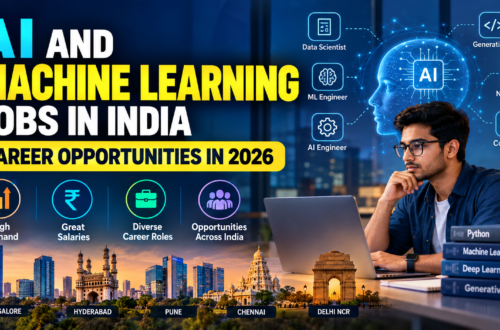
Bangalore: Opportunities across AI product development, Machine Learning Engineering, Generative AI, and enterprise technology.
Hyderabad: Career opportunities involving cloud-based AI systems, data engineering, intelligent automation, and enterprise applications.
Pune: Roles across industrial AI, predictive analytics, automotive technology, and software development.
Chennai: Opportunities in computer vision, manufacturing automation, enterprise software, and data science.
Delhi NCR: Positions involving AI consulting, financial technology, e-commerce analytics, and digital product development.
Additionally, Mumbai and Kolkata offer opportunities in banking technology, analytics, and enterprise software.
Therefore, candidates should explore positions based on their technical skills, preferred location, and professional experience.
How to Demonstrate AI and ML Skills During Job Interviews
Employers frequently assess practical knowledge during AI and Machine Learning interviews.
Therefore, candidates should prepare to explain their projects, programming decisions, and model evaluation methods.
For example, interviewers may ask how you selected a machine learning algorithm, handled missing data, improved model performance, or deployed an application.
Additionally, candidates applying for Generative AI positions may face questions about LLMs, embeddings, RAG architectures, hallucinations, and AI application security.
A strong GitHub portfolio can help demonstrate practical capabilities.
Moreover, candidates should prepare clear explanations of the business problems addressed by their projects.
AI and Machine Learning Recruitment Opportunities in India
As organisations explore AI-powered business solutions, identifying professionals with relevant technical expertise becomes an important recruitment requirement.
Employers may seek specialists in Python, Machine Learning, Deep Learning, Generative AI, NLP, Computer Vision, and MLOps.
Cybotrix Technologies provides IT recruitment and staffing support to organisations seeking skilled technology professionals.
For companies planning to expand their AI teams, our AI and ML Engineer recruitment services in Bangalore help employers identify professionals with relevant technical knowledge, project experience, and qualifications.
Meanwhile, job seekers can strengthen their career prospects by developing practical skills, completing relevant projects, and preparing for technical interviews.
Frequently Asked Questions
What are the most important skills required for AI and ML jobs in India?
Python, Machine Learning algorithms, Statistics, SQL, Deep Learning, and data processing are important foundational skills. Additionally, cloud computing, Generative AI, and MLOps are valuable for specialised engineering roles.
Is Python enough to get an AI Engineer job?
Python is an important starting point. However, most AI engineering positions also require knowledge of Machine Learning, data processing, software development, and practical project implementation.
Can freshers get AI and ML jobs without experience?
Yes. Freshers can explore internships, trainee positions, and junior development roles. However, practical projects and programming skills can improve their employment prospects.
Is Generative AI important for AI jobs in 2026?
Generative AI is relevant for positions involving LLM applications, intelligent automation, document processing, and conversational AI. Nevertheless, traditional Machine Learning and software engineering skills remain important.
Do AI Engineers need mathematics?
Yes. Statistics, probability, linear algebra, and optimisation help engineers understand machine learning algorithms and evaluate model performance.
Which skill should I learn first for an AI career?
Python is a practical starting point for many candidates. Afterwards, learning SQL, statistics, data analysis, and Machine Learning fundamentals provides a strong foundation.
Conclusion
Understanding the top 15 skills required for AI and ML jobs in India can help freshers and experienced professionals prepare for emerging technology careers.
Python, Machine Learning, Statistics, Deep Learning, and data analysis provide essential foundations. Moreover, specialised technologies such as Generative AI, NLP, Cloud Computing, and MLOps can support advanced career development.
However, learning tools alone is not enough. Candidates should focus on practical projects, problem-solving, software engineering fundamentals, and continuous technical improvement.
As organisations continue adopting intelligent technologies, professionals who combine strong technical knowledge with real-world application experience will be better prepared to pursue suitable AI career opportunities.
Cybotrix Technologies supports employers and technology professionals through IT recruitment and staffing services across India’s major technology markets.
Australia Birmingham Bristol Cambridge Canada Edinburgh France Germany HRMS HR Payroll HR Technology India Ireland Leeds London Manchester Netherlands Noida Norway Nottingham Oxford Payroll Careers Payroll Compliance Payroll Jobs Payroll Management Payroll Outsourcing Payroll Services Poland Reading Salary Processing Singapore Sweden Switzerland Tax Compliance UAE UK USA