How to Get an AI Engineer Job in India as a Fresher
Artificial Intelligence (AI) is creating new career opportunities across India’s technology industry. As businesses adopt machine learning, Generative AI, and intelligent automation, fresh graduates are exploring ways to enter this rapidly evolving field. However, getting an AI Engineer job in India as a fresher requires more than completing a degree or learning basic programming.
Employers increasingly look for candidates who understand AI concepts, can write clean Python code, and have experience developing practical projects. Therefore, freshers should focus on building technical skills, gaining hands-on experience, and preparing for real-world engineering challenges.
Whether you have completed B.Tech, BE, BCA, MCA, MSc, or another relevant qualification, this guide explains how to start your AI engineering career in India in 2026.
What Does an AI Engineer Do?
An AI Engineer develops software applications that use artificial intelligence to solve business problems. These professionals work with machine learning models, data processing systems, automation tools, and AI development frameworks.
For example, an AI Engineer may build a customer support chatbot, develop a recommendation engine, or integrate a Large Language Model (LLM) into an enterprise application.
Additionally, AI Engineers collaborate with software developers, data scientists, and cloud engineers to develop reliable AI-powered systems.
Typical responsibilities include:
- Developing AI and machine learning applications using Python.
- Preparing and processing datasets for model training.
- Building predictive models using machine learning algorithms.
- Integrating Generative AI and LLM APIs into applications.
- Testing, evaluating, and improving AI model performance.
- Deploying AI applications using cloud platforms.
- Maintaining technical documentation and application reliability.
Although responsibilities vary between companies, programming knowledge and practical problem-solving skills remain essential.
Step 1: Learn Python Programming
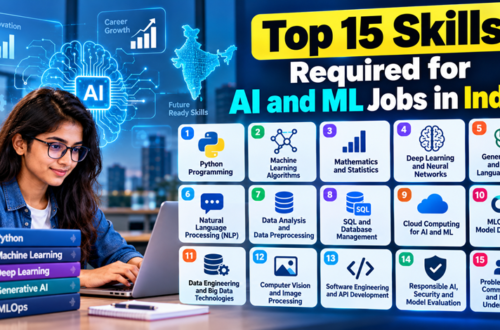
Python is one of the most widely used programming languages for Artificial Intelligence and Machine Learning. Therefore, freshers should begin by developing a strong foundation in Python.
Start with variables, data types, loops, functions, lists, dictionaries, and object-oriented programming. Afterwards, learn file handling, exception handling, APIs, and basic data structures.
In addition, become familiar with important Python libraries.
NumPy: Supports numerical calculations and array operations.
Pandas: Helps clean, organise, and analyse datasets.
Matplotlib: Provides tools for creating charts and visualising data.
Scikit-learn: Supports traditional machine learning model development.
TensorFlow and PyTorch: Help developers build and train deep learning models.
Most importantly, practise writing programs independently. A strong understanding of Python will make advanced AI concepts easier to learn.
Step 2: Understand Machine Learning Fundamentals
After learning Python, the next step is understanding how machine learning algorithms work.
Machine learning allows computer systems to identify patterns in data and make predictions without relying entirely on explicitly programmed rules.
Freshers should focus on the following concepts:
- Supervised and unsupervised learning.
- Linear regression and logistic regression.
- Decision trees and random forests.
- Classification and clustering algorithms.
- Feature selection and feature engineering.
- Model training and testing.
- Overfitting and underfitting.
- Model evaluation and cross-validation.
Furthermore, learn how to evaluate models using accuracy, precision, recall, F1-score, and other appropriate metrics.
Instead of memorising algorithms, understand when and why each technique should be used. Consequently, you will be better prepared to explain your technical decisions during interviews.
Step 3: Build Knowledge of Deep Learning and Generative AI
Deep Learning and Generative AI are important areas of modern artificial intelligence development.
Once you understand basic machine learning, explore neural networks, activation functions, backpropagation, and deep learning architectures.
Additionally, learn how Large Language Models work and how developers integrate them into software applications.
Important topics include:
- Artificial Neural Networks (ANN).
- Convolutional Neural Networks (CNN).
- Transformer architectures.
- Natural Language Processing (NLP).
- Large Language Models (LLMs).
- Prompt engineering.
- Retrieval-Augmented Generation (RAG).
- Vector databases and embeddings.
- AI model evaluation.
However, freshers do not need to master every advanced topic before applying for their first job. Instead, develop a strong understanding of fundamental concepts and gain practical experience in one or two specialisations.
Step 4: Develop Practical AI Projects
Practical projects are among the most effective ways to demonstrate your AI development skills.
Although academic qualifications are valuable, employers often want evidence that candidates can apply their knowledge to real problems.
Therefore, create projects that include data preparation, model development, evaluation, and application deployment.
Project 1: AI-Powered Chatbot
Develop a chatbot using Python and an LLM API. Additionally, build a simple interface that allows users to interact with the application.
This project can demonstrate API integration, prompt design, and application development skills.
Project 2: Customer Churn Prediction
Build a machine learning model that predicts whether customers may stop using a service.
Use Pandas for data preparation and Scikit-learn for model development. Afterwards, evaluate the model using suitable performance metrics.
Project 3: Resume Screening Application
Create a basic application that extracts relevant skills and information from resumes.
Furthermore, implement keyword matching or semantic similarity techniques to compare candidate profiles with job requirements.
Use appropriate safeguards for personal information, and avoid treating automated scores as final hiring decisions.
Project 4: Sentiment Analysis System
Develop an NLP application that classifies text into positive, negative, or neutral sentiment categories.
This project can help demonstrate text preprocessing, classification, and model evaluation skills.
Project 5: Document-Based AI Assistant
Build a Retrieval-Augmented Generation application that answers questions using information from uploaded documents.
As a result, you can demonstrate practical knowledge of embeddings, vector databases, document retrieval, and LLM integration.
Career Tip: Upload your projects to GitHub with a clear README, installation instructions, screenshots, and explanations of the technologies used.
Step 5: Learn SQL, APIs, and Cloud Computing
AI Engineers rarely work with machine learning models alone. Instead, they often develop applications that interact with databases, APIs, and cloud infrastructure.
Therefore, freshers should learn SQL fundamentals, REST APIs, Git, and basic deployment concepts.
Knowledge of AWS, Microsoft Azure, or Google Cloud can also support entry-level AI application development.
Moreover, understanding Docker and FastAPI can help you deploy machine learning models as usable software services.
You do not need advanced cloud certifications for every fresher position. However, demonstrating that you can deploy and test an application can strengthen your portfolio.
Step 6: Apply for AI Internships and Entry-Level Jobs
Getting a full-time AI Engineer position immediately after graduation can be challenging because some employers prefer candidates with practical experience.
Therefore, freshers should consider internships, trainee positions, and related software development opportunities.
Suitable entry-level job titles include:
- AI Engineer Trainee
- Junior AI Developer
- Machine Learning Intern
- AI Development Intern
- Junior Python Developer
- Associate Machine Learning Engineer
- Data Science Intern
- Junior Data Analyst
- Generative AI Developer Intern
Additionally, candidates can explore software engineering positions involving Python, APIs, automation, or data processing.
These roles may provide valuable experience and create opportunities to transition into specialised AI engineering positions.
Step 7: Prepare an ATS-Friendly AI Engineer Resume
An effective resume should clearly demonstrate your technical knowledge, practical projects, and educational qualifications.
For freshers, a one-page resume is often sufficient.
Include the following information:
Professional Summary: Write a short introduction highlighting your Python, Machine Learning, and AI development skills.
Technical Skills: Mention relevant programming languages, frameworks, databases, and tools.
Projects: Describe two or three practical projects with technologies used and measurable results where available.
Education: Include your degree, institution, and graduation year.
Internships: Highlight relevant training, internships, or technical experience.
GitHub and Portfolio: Provide links to completed projects and demonstrations.
Furthermore, use relevant keywords from the job description naturally. However, avoid listing tools or technologies you cannot explain during an interview.
Step 8: Prepare for AI Engineer Interviews
AI Engineer interviews for freshers generally focus on programming fundamentals, machine learning concepts, mathematical knowledge, and project experience.
Therefore, prepare for both technical questions and practical coding exercises.
Common interview questions include:
- What is Artificial Intelligence, and how is it different from Machine Learning?
- What is the difference between supervised and unsupervised learning?
- How do you handle missing values in a dataset?
- What is overfitting, and how can it be reduced?
- What is the difference between classification and regression?
- What are precision, recall, and F1-score?
- How do neural networks work?
- What is the purpose of a transformer model?
- What is Retrieval-Augmented Generation?
- How would you deploy a machine learning model?
In addition, practise Python coding problems involving lists, dictionaries, strings, functions, and basic algorithms.
Most importantly, prepare to explain your projects from beginning to end. Interviewers may ask why you selected a particular algorithm, how you evaluated the results, and what improvements you would make.
Best Cities to Find AI Engineer Jobs for Freshers in India
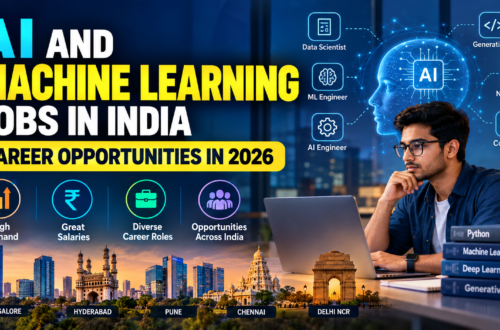
India offers AI-related opportunities across several major technology markets.
Bangalore
Bangalore has an established ecosystem of technology startups, software product companies, and multinational organisations. Consequently, freshers can explore internships and junior positions involving AI development, Python programming, and machine learning.
Hyderabad
Hyderabad offers opportunities across enterprise software, cloud technology, data analytics, and intelligent automation. Additionally, global technology companies and IT service providers contribute to the local employment market.
Pune
Pune provides opportunities in software development, data analytics, industrial automation, and machine learning applications. Therefore, candidates with Python and analytical skills can explore relevant entry-level positions.
Chennai
Chennai offers career opportunities across IT services, enterprise software, manufacturing technology, and data engineering. Moreover, AI applications in automation and computer vision provide specialised learning pathways.
Delhi NCR
Noida, Gurgaon, and Delhi have technology companies working in financial technology, e-commerce, software services, and AI-enabled applications.
Meanwhile, Mumbai and Kolkata also offer opportunities in analytics, banking technology, and software development.
AI Engineer Salary in India for Freshers in 2026
Entry-level AI Engineer salaries depend on technical skills, company size, job responsibilities, and location.
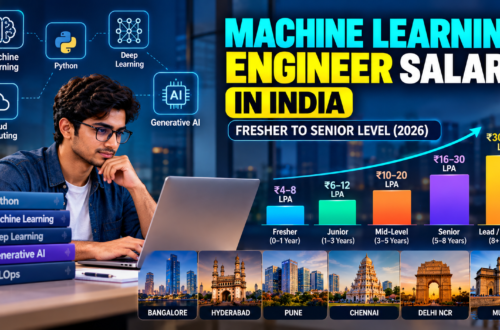
For general career planning, a broad illustrative starting range is approximately ₹4–8 LPA. However, this is not a verified 2026 market average, and actual offers may be lower or higher.
For example, candidates with strong programming abilities, internships, and practical AI project experience may qualify for more competitive positions.
Nevertheless, freshers should evaluate learning opportunities, mentorship, job responsibilities, and long-term career development alongside salary.
Common Mistakes Freshers Should Avoid
Many candidates complete AI courses but struggle to demonstrate their practical knowledge during interviews.
Therefore, avoid these common mistakes:
- Learning only theoretical concepts without building projects.
- Ignoring Python programming fundamentals.
- Copying GitHub projects without understanding the code.
- Listing too many technologies without practical experience.
- Applying only for senior-level AI positions.
- Neglecting SQL, APIs, and software engineering basics.
- Preparing for interviews without practising coding.
- Depending entirely on certificates instead of demonstrated skills.
Instead, focus on developing a smaller number of complete projects that you can confidently explain.
How Long Does It Take to Become Job-Ready for an AI Engineer Role?
The learning timeline depends on your existing programming knowledge, educational background, and available study time.
For beginners, a structured six-month learning plan can provide a useful starting point.
Month 1: Learn Python programming, data structures, and basic SQL.
Month 2: Study NumPy, Pandas, statistics, and data analysis.
Month 3: Learn machine learning algorithms and model evaluation.
Month 4: Explore deep learning, NLP, and Generative AI fundamentals.
Month 5: Develop practical projects and learn basic application deployment.
Month 6: Build your GitHub portfolio, prepare your resume, practise interviews, and apply for internships or junior positions.
However, completing this plan does not guarantee employment. Some candidates may require additional time to strengthen their programming skills and project experience.
AI Recruitment and Hiring Opportunities in Bangalore
As organisations invest in AI-powered applications, hiring qualified professionals with relevant technical expertise becomes an important business requirement.
Companies seeking experienced AI specialists can explore professional recruitment support to identify candidates with expertise in machine learning, Generative AI, NLP, and related technologies.
For example, Cybotrix Technologies provides recruitment services to organisations looking to hire AI and ML engineers in Bangalore. The service focuses on helping employers identify professionals with relevant AI development skills, technical experience, and project backgrounds.
Meanwhile, freshers can improve their career prospects by developing practical skills and preparing for entry-level opportunities in India’s technology industry.
Frequently Asked Questions
Can I become an AI Engineer as a fresher in India?
Yes. Fresh graduates can pursue AI internships, trainee positions, and junior development opportunities. However, practical programming skills and relevant projects are important for improving employability.
Is Python compulsory for AI Engineer jobs?
Python is widely used in AI and Machine Learning development. Therefore, learning Python is highly recommended, although specific programming requirements depend on the employer.
Can BCA and MCA graduates apply for AI Engineer jobs?
Yes. BCA and MCA graduates can apply for suitable AI-related positions. Additionally, strong programming knowledge, practical projects, and relevant technical experience can improve their applications.
Do freshers need Deep Learning knowledge for AI jobs?
Not every entry-level position requires advanced Deep Learning expertise. However, understanding neural networks and basic deep learning concepts can help candidates prepare for specialised roles.
Is Generative AI a good career option for freshers?
Generative AI offers opportunities in application development, AI integration, automation, and LLM-based software solutions. Nevertheless, freshers should first develop strong Python and software engineering fundamentals.
Can I get an AI Engineer job without an internship?
Yes, it is possible. However, internships can provide valuable practical experience. Candidates without internships should demonstrate their capabilities through completed projects, technical portfolios, and coding skills.
Conclusion
Getting an AI Engineer job in India as a fresher requires a combination of technical knowledge, practical experience, and consistent preparation.
Start by learning Python, understanding Machine Learning fundamentals, and developing real-world AI projects. Afterwards, explore Generative AI, cloud computing, and model deployment to strengthen your technical profile.
Furthermore, create an effective resume, maintain an active GitHub portfolio, and prepare thoroughly for technical interviews.
Although competition for entry-level AI positions can be significant, candidates who demonstrate strong fundamentals and practical problem-solving abilities can improve their chances of finding suitable opportunities.
As India’s technology industry continues exploring AI-powered solutions, freshers who invest in relevant skills and continuous learning will be better prepared to begin their careers in Artificial Intelligence.