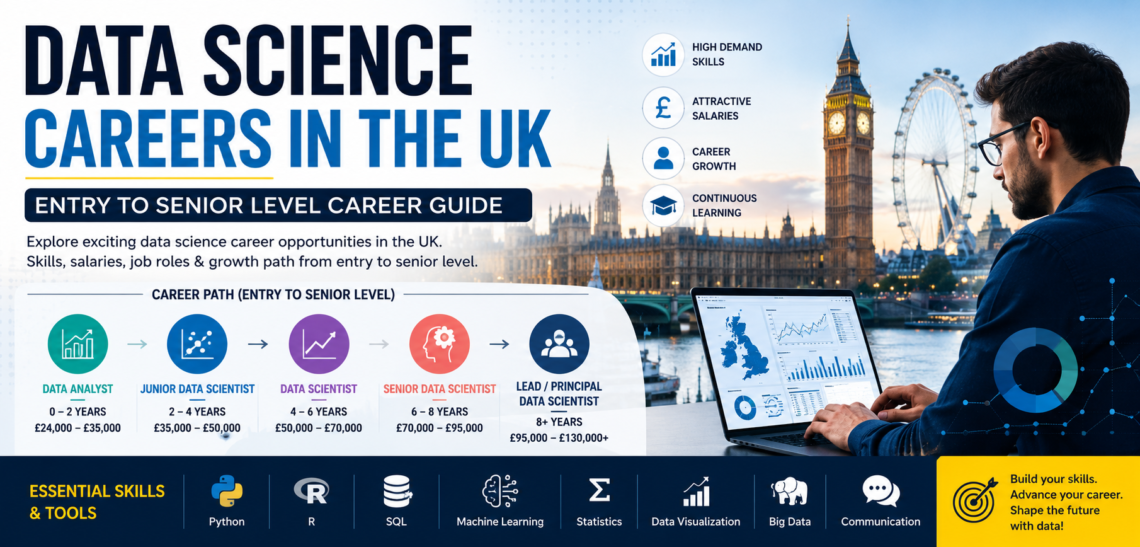
Data Science Careers in the UK: Complete Guide from Entry Level to Senior Roles (2026)
Data Science has become one of the fastest-growing and highest-paying career paths in the United Kingdom. Organizations across industries are using data to make informed decisions, improve customer experiences, optimize business operations, and develop innovative products. As a result, demand for skilled data professionals continues to rise, making Data Science Careers in the UK an attractive option for graduates, career changers, and experienced IT professionals.
From global technology companies and financial institutions to healthcare providers, retailers, logistics firms, and government organizations, businesses are investing heavily in data-driven decision-making. Professionals who can collect, clean, analyze, and interpret large datasets are increasingly valuable in today’s digital economy.
Whether you aspire to become a Data Analyst, Data Scientist, Machine Learning Engineer, Data Engineer, Business Intelligence Analyst, or Chief Data Officer, the UK offers excellent opportunities with competitive salaries, career growth, and the chance to work on impactful projects.
In this comprehensive guide, you’ll learn:
- Why Data Science is booming in the UK
- Entry-level to senior career opportunities
- Essential technical and analytical skills
- Salary expectations
- Career roadmap
- Top employers
- Industry certifications
- Future job trends
If you’re planning to build a career in Data Science, this guide will help you understand the complete journey from beginner to senior leadership.
Why Data Science Careers Are Growing in the UK
Data is often referred to as the “new oil” because it powers decision-making, innovation, and business growth. Every organization generates massive amounts of data through customer interactions, online transactions, connected devices, and internal operations. Turning this raw data into actionable insights requires skilled data professionals.
Several factors are driving the rapid growth of Data Science careers across the UK.
Digital Transformation
Businesses are investing in digital platforms, cloud computing, e-commerce, artificial intelligence, and automation. These technologies generate vast amounts of data that need to be analyzed for better decision-making.
Artificial Intelligence and Machine Learning
AI and Machine Learning rely on high-quality data. As organizations adopt predictive analytics, recommendation systems, fraud detection, and intelligent automation, the demand for Data Scientists continues to grow.
Cloud Adoption
Cloud platforms such as AWS, Microsoft Azure, and Google Cloud have made it easier to store and process large datasets. This has increased demand for professionals who understand cloud-based data solutions.
Business Intelligence
Organizations want real-time insights into sales, customer behavior, operational efficiency, and market trends. Business Intelligence (BI) professionals play a key role in transforming data into strategic decisions.
Skills Shortage
There is a shortage of experienced Data Scientists, Data Engineers, and Machine Learning Engineers in the UK. Companies compete for skilled professionals by offering attractive salaries, flexible work arrangements, and career development opportunities.
What Is Data Science?
Data Science is an interdisciplinary field that combines statistics, mathematics, programming, machine learning, and domain expertise to extract meaningful insights from structured and unstructured data.
Data Science professionals work on tasks such as:
- Collecting and cleaning data
- Analyzing business trends
- Building predictive models
- Developing machine learning algorithms
- Creating dashboards and reports
- Identifying customer behavior patterns
- Forecasting future outcomes
- Supporting business decision-making
A successful Data Scientist combines technical expertise with strong analytical thinking and communication skills.
Industries Hiring Data Science Professionals in the UK
Data Science skills are valuable across almost every industry.
Banking and Financial Services
Financial institutions use Data Science for:
- Fraud detection
- Credit risk analysis
- Customer segmentation
- Investment analytics
- Financial forecasting
Major employers include:
- HSBC
- Barclays
- Lloyds Banking Group
- NatWest
- Revolut
Healthcare
Healthcare organizations use data analytics to:
- Predict disease outbreaks
- Improve patient care
- Analyze clinical outcomes
- Support drug discovery
- Optimize hospital operations
Retail and E-commerce
Retail businesses use Data Science for:
- Product recommendations
- Customer behavior analysis
- Inventory forecasting
- Demand prediction
- Dynamic pricing
Technology
Technology companies develop AI-powered products, search engines, recommendation systems, and intelligent applications that depend heavily on Data Science.
Manufacturing
Manufacturers analyze production data to improve quality, reduce downtime, and optimize supply chains through predictive maintenance and analytics.
Telecommunications
Telecommunication providers analyze network performance, customer usage patterns, and churn rates to improve service quality and retention.
Logistics and Transportation
Logistics companies use Data Science to:
- Optimize delivery routes
- Forecast demand
- Manage fleets
- Improve warehouse operations
Government and Public Sector
Government organizations use analytics for policy development, resource allocation, fraud detection, and public service improvements.
Data Science Career Levels
A typical Data Science career progresses through multiple stages.
Entry Level
- Data Analyst
- Junior Data Scientist
- Reporting Analyst
- Business Intelligence Analyst
- Junior Machine Learning Engineer
- Analytics Associate
Mid-Level
- Data Scientist
- Machine Learning Engineer
- Data Engineer
- BI Developer
- Analytics Consultant
- Senior Data Analyst
Senior Level
- Senior Data Scientist
- Lead Data Scientist
- Principal Data Scientist
- Data Science Manager
- Head of Data Science
- Chief Data Officer (CDO)
Entry-Level Data Science Jobs in the UK
Entry-level roles help build practical experience in data analysis, programming, visualization, and business intelligence.
1. Data Analyst
Data Analysts collect, clean, analyze, and visualize data to help organizations make informed decisions.
Responsibilities
- Data cleaning
- Dashboard development
- Report generation
- SQL queries
- Trend analysis
- Business reporting
Required Skills
- Excel
- SQL
- Power BI
- Tableau
- Python (basic)
- Statistics
Average Salary
£30,000–£45,000
2. Junior Data Scientist
Junior Data Scientists assist in building predictive models and analyzing datasets under the guidance of senior team members.
Responsibilities
- Data preprocessing
- Exploratory Data Analysis (EDA)
- Feature engineering
- Machine learning model development
- Model evaluation
Skills
- Python
- Pandas
- NumPy
- Scikit-learn
- SQL
- Statistics
Average Salary
£35,000–£50,000
3. Business Intelligence (BI) Analyst
BI Analysts transform business data into dashboards and actionable insights for management teams.
Responsibilities
- Dashboard creation
- KPI reporting
- Business analysis
- Data visualization
- Trend monitoring
Popular Tools
- Power BI
- Tableau
- Looker Studio
- Excel
- SQL
Average Salary
£35,000–£50,000
4. Reporting Analyst
Reporting Analysts focus on creating automated reports and monitoring business performance metrics.
Responsibilities
- Develop reports
- SQL query writing
- Data validation
- Dashboard automation
- Performance analysis
Salary
£32,000–£45,000
5. Junior Machine Learning Engineer
This role focuses on implementing machine learning algorithms and supporting AI projects.
Responsibilities
- Prepare training datasets
- Build ML pipelines
- Train models
- Evaluate algorithms
- Collaborate with Data Scientists
Skills
- Python
- Scikit-learn
- TensorFlow (basic)
- PyTorch (basic)
- SQL
- Git
Average Salary
£38,000–£55,000
Essential Skills for Entry-Level Data Science Professionals
Employers look for a strong foundation in programming, mathematics, and analytical thinking.
Programming
Learn:
- Python
- SQL
- R (optional)
Data Analysis
Develop expertise in:
- Excel
- Pandas
- NumPy
- Data Cleaning
- Data Wrangling
Data Visualization
Master tools such as:
- Power BI
- Tableau
- Matplotlib
- Plotly
- Seaborn
Statistics
Key concepts include:
- Mean
- Median
- Standard Deviation
- Probability
- Hypothesis Testing
- Correlation
- Regression
Mathematics
A solid understanding of the following is valuable:
- Linear Algebra
- Calculus (basic)
- Matrix Operations
- Optimization
Soft Skills
Successful Data Science professionals also demonstrate:
- Problem-solving
- Analytical thinking
- Communication
- Business understanding
- Team collaboration
- Presentation skills
- Curiosity
- Continuous learning
Career Roadmap: Entry Level to Senior Data Scientist
Step 1: Learn Python
Focus on:
- Variables
- Functions
- Loops
- Object-Oriented Programming
- File Handling
Step 2: Learn SQL
Practice:
- Joins
- Aggregations
- Window Functions
- Common Table Expressions (CTEs)
- Query Optimization
Step 3: Master Data Analysis
Build skills in:
- Data Cleaning
- Exploratory Data Analysis (EDA)
- Data Visualization
- Dashboard Development
Step 4: Learn Statistics
Understand:
- Probability
- Regression
- Classification
- Sampling
- Statistical Testing
Step 5: Build Projects
Create portfolio projects such as:
- Sales Dashboard
- Customer Churn Prediction
- Loan Default Prediction
- House Price Prediction
- Sales Forecasting
- Customer Segmentation
Publishing these projects on GitHub with clear documentation helps demonstrate your practical skills to employers.
Data Science Salary in the UK (2026)
Data Science professionals continue to be among the highest-paid technology specialists in the UK due to increasing demand for analytics, Artificial Intelligence, Machine Learning, and cloud-based data platforms.
Average Salary by Experience
| Experience | Average Annual Salary |
|---|---|
| Entry Level (0–1 Year) | £32,000–£45,000 |
| Junior (1–3 Years) | £45,000–£60,000 |
| Mid-Level (3–5 Years) | £60,000–£80,000 |
| Senior (5–8 Years) | £80,000–£110,000 |
| Lead Data Scientist | £95,000–£130,000 |
| Principal Data Scientist | £110,000–£145,000 |
| Head of Data Science | £120,000–£170,000 |
| Chief Data Officer (CDO) | £150,000–£250,000+ |
Salary by Job Role
| Job Role | Average Salary |
|---|---|
| Data Analyst | £35,000–£55,000 |
| BI Analyst | £35,000–£55,000 |
| Data Scientist | £55,000–£85,000 |
| Machine Learning Engineer | £65,000–£100,000 |
| Data Engineer | £60,000–£95,000 |
| Analytics Consultant | £60,000–£95,000 |
| AI Data Scientist | £75,000–£120,000 |
| Lead Data Scientist | £95,000–£130,000 |
| Principal Data Scientist | £110,000–£145,000 |
| Chief Data Officer | £150,000–£250,000+ |
Salary by UK City
| City | Average Salary |
|---|---|
| London | £70,000–£130,000 |
| Cambridge | £65,000–£120,000 |
| Manchester | £55,000–£90,000 |
| Edinburgh | £60,000–£95,000 |
| Bristol | £58,000–£95,000 |
| Birmingham | £50,000–£85,000 |
| Leeds | £50,000–£85,000 |
| Glasgow | £48,000–£82,000 |
London continues to offer the highest salaries due to the concentration of technology companies, financial institutions, consulting firms, and AI startups.
Mid-Level Data Science Careers
Professionals with 3–6 years of experience often specialize in predictive analytics, machine learning, big data engineering, or cloud analytics.
1. Data Scientist
Data Scientists build predictive models, perform statistical analysis, and generate insights to support strategic business decisions.
Responsibilities
- Predictive analytics
- Machine learning
- Statistical modelling
- Business problem solving
- Feature engineering
- Model deployment
Skills
- Python
- SQL
- Pandas
- NumPy
- Scikit-learn
- Power BI
- Tableau
Average Salary
£55,000–£85,000
2. Machine Learning Engineer
Machine Learning Engineers develop, optimize, and deploy machine learning models into production environments.
Responsibilities
- Model training
- ML pipelines
- Model optimization
- Production deployment
- Feature engineering
Tools
- TensorFlow
- PyTorch
- MLflow
- Kubeflow
- Docker
- Kubernetes
Salary
£65,000–£100,000
3. Data Engineer
Data Engineers build reliable data pipelines and infrastructure that enable analytics and machine learning.
Responsibilities
- ETL pipelines
- Data warehousing
- Data integration
- Pipeline automation
- Database optimization
Technologies
- Apache Spark
- Hadoop
- Kafka
- Airflow
- Snowflake
- Databricks
Salary
£60,000–£95,000
4. Business Intelligence Developer
BI Developers design enterprise dashboards and reporting solutions that provide actionable business insights.
Responsibilities
- Dashboard development
- KPI reporting
- Data modelling
- Report automation
- Performance optimization
Tools
- Power BI
- Tableau
- Looker
- SQL Server Reporting Services (SSRS)
Salary
£50,000–£80,000
5. Analytics Consultant
Analytics Consultants advise organizations on using data to improve operational efficiency and business strategy.
Responsibilities
- Business analysis
- Customer analytics
- Predictive modelling
- Executive reporting
- Data strategy
Salary
£60,000–£95,000
Senior Data Science Careers
Experienced professionals often move into leadership, architecture, or enterprise AI roles.
1. Senior Data Scientist
Senior Data Scientists lead complex analytical initiatives, mentor junior team members, and drive innovation.
Responsibilities
- Advanced predictive modelling
- AI strategy
- Model governance
- Cross-functional collaboration
- Technical leadership
Salary
£80,000–£110,000
2. Lead Data Scientist
Lead Data Scientists oversee data science teams and ensure projects align with organizational objectives.
Responsibilities
- Team leadership
- Project planning
- Stakeholder management
- AI solution design
- Quality assurance
Salary
£95,000–£130,000
3. Principal Data Scientist
Principal Data Scientists define long-term AI and analytics strategies while solving complex technical challenges.
Salary
£110,000–£145,000
4. Head of Data Science
This leadership role manages enterprise-wide data science initiatives, budgets, and teams.
Responsibilities
- Build data strategy
- Manage teams
- Allocate resources
- Collaborate with executives
- Drive innovation
Salary
£120,000–£170,000
5. Chief Data Officer (CDO)
The Chief Data Officer is responsible for an organization’s overall data strategy, governance, analytics, and AI initiatives.
Responsibilities
- Enterprise data governance
- AI strategy
- Regulatory compliance
- Data quality
- Business transformation
Salary
£150,000–£250,000+
Programming Languages Every Data Scientist Should Learn
Python
Python is the industry standard for Data Science.
Popular libraries:
- Pandas
- NumPy
- Scikit-learn
- TensorFlow
- PyTorch
- Matplotlib
- Plotly
- XGBoost
SQL
Nearly every Data Science role requires SQL.
Topics include:
- Joins
- Aggregations
- Window Functions
- CTEs
- Stored Procedures
- Query Optimization
R
Widely used in:
- Statistical modelling
- Academic research
- Data visualization
Scala
Useful for:
- Apache Spark
- Big Data processing
Machine Learning Skills
Employers expect practical experience with algorithms such as:
- Linear Regression
- Logistic Regression
- Decision Trees
- Random Forest
- Support Vector Machines
- K-Means Clustering
- XGBoost
- LightGBM
Deep Learning Skills
Increasingly valuable in AI-focused Data Science roles.
Learn:
- Artificial Neural Networks
- CNN
- RNN
- LSTM
- Transformers
- Transfer Learning
Popular frameworks:
- TensorFlow
- PyTorch
- Keras
Big Data Technologies
Large organizations process petabytes of information daily.
Important technologies include:
- Apache Spark
- Hadoop
- Hive
- Kafka
- Databricks
- Snowflake
- Delta Lake
Cloud Platforms for Data Science
Cloud expertise is becoming essential.
Amazon Web Services (AWS)
Popular services:
- SageMaker
- S3
- Lambda
- Athena
- Redshift
- Glue
Microsoft Azure
Key services:
- Azure Machine Learning
- Synapse Analytics
- Data Factory
- Azure Databricks
Google Cloud Platform
Popular tools:
- BigQuery
- Vertex AI
- Cloud Storage
- Dataflow
Data Visualization Skills
Business stakeholders expect insights to be presented clearly.
Popular visualization tools include:
- Power BI
- Tableau
- Looker Studio
- Matplotlib
- Plotly
- Seaborn
Mathematics for Data Science
A solid understanding of mathematics strengthens your ability to develop and interpret models.
Topics include:
- Linear Algebra
- Probability
- Statistics
- Calculus
- Optimization
- Bayesian Inference
Best Data Science Certifications
Professional certifications can help validate your skills and improve your employability.
Beginner
- Google Data Analytics Professional Certificate
- Microsoft Power BI Data Analyst Associate
- IBM Data Science Professional Certificate
Intermediate
- AWS Certified Machine Learning – Specialty
- Microsoft Azure Data Scientist Associate
- Databricks Data Engineer Associate
Advanced
- Google Professional Machine Learning Engineer
- TensorFlow Developer Certificate
- Snowflake SnowPro Core Certification
- SAS Certified Data Scientist
Top Universities in the UK for Data Science
Many UK universities offer world-class Data Science and AI programs.
- University of Oxford
- University of Cambridge
- Imperial College London
- University College London (UCL)
- University of Edinburgh
- University of Manchester
- King’s College London
- University of Bristol
- University of Warwick
- University of Southampton
Graduates from these institutions are highly sought after by leading employers.
Top Companies Hiring Data Scientists in the UK
Data Science professionals are recruited across multiple industries.
Technology
- Microsoft
- Amazon
- IBM
- Oracle
- NVIDIA
- Meta
Financial Services
- HSBC
- Barclays
- Lloyds Banking Group
- NatWest
- Revolut
Consulting
- Deloitte
- Accenture
- PwC
- EY
- KPMG
Healthcare
- AstraZeneca
- GSK
- NHS
- BenevolentAI
Retail & E-commerce
- Tesco
- Ocado
- ASOS
- Amazon UK
Skills Employers Want in 2026
Recruiters increasingly look for professionals who combine technical expertise with business understanding.
Technical Skills
- Python
- SQL
- Machine Learning
- Deep Learning
- Statistics
- Data Visualization
- Cloud Computing
- Spark
- Databricks
- Docker
- Git
- MLOps
Business Skills
- Communication
- Stakeholder Management
- Problem Solving
- Presentation Skills
- Business Intelligence
- Critical Thinking
Data Science Interview Questions
Recruiters generally evaluate candidates in five major areas:
- Programming
- SQL & Databases
- Statistics & Mathematics
- Machine Learning
- Business Problem Solving
Python Interview Questions
Python is the most widely used programming language in Data Science.
Common interview questions include:
- Why is Python preferred for Data Science?
- Difference between lists and tuples.
- Explain dictionaries and sets.
- What are decorators?
- Explain generators.
- Difference between NumPy arrays and Python lists.
- What is Pandas?
- Explain DataFrames.
- What is vectorization?
- Explain lambda functions.
- Difference between deep copy and shallow copy.
- What are virtual environments?
- Explain object-oriented programming.
- What are Python packages?
- Explain exception handling.
SQL Interview Questions
SQL remains one of the most important skills for Data Scientists.
Frequently asked questions:
- Difference between WHERE and HAVING.
- Explain INNER JOIN and LEFT JOIN.
- What are window functions?
- What are Common Table Expressions (CTEs)?
- Explain indexes.
- Difference between DELETE, DROP, and TRUNCATE.
- How do you identify duplicate records?
- Explain normalization.
- What is denormalization?
- Difference between clustered and non-clustered indexes.
- Explain GROUP BY.
- What are aggregate functions?
- How do you optimize SQL queries?
Statistics Interview Questions
Statistics forms the foundation of predictive analytics.
Popular questions include:
- Mean vs Median.
- Standard deviation.
- Variance.
- Probability distributions.
- Central Limit Theorem.
- Hypothesis testing.
- p-value.
- Confidence intervals.
- Correlation vs causation.
- Linear regression assumptions.
- Precision and recall.
- F1 Score.
- ROC Curve.
- AUC.
- Bias-variance tradeoff.
Machine Learning Interview Questions
Machine Learning is a core component of modern Data Science roles.
Interview questions often include:
- What is Machine Learning?
- Types of Machine Learning.
- Supervised vs Unsupervised Learning.
- Explain regression.
- Explain classification.
- What is clustering?
- Decision Trees.
- Random Forest.
- XGBoost.
- LightGBM.
- Cross-validation.
- Feature engineering.
- Feature selection.
- Overfitting.
- Underfitting.
- Gradient Descent.
- Ensemble Learning.
- Hyperparameter tuning.
Deep Learning Questions
Advanced Data Science positions often include Deep Learning topics.
Examples:
- Artificial Neural Networks
- Activation functions
- CNN
- RNN
- LSTM
- Transformers
- Backpropagation
- Transfer Learning
- Attention mechanism
- Fine-tuning
HR Interview Questions
Recruiters also evaluate communication and business understanding.
Examples:
- Tell me about yourself.
- Why Data Science?
- Explain your best project.
- Describe a difficult problem you solved.
- How do you communicate technical findings?
- What motivates you?
- Why should we hire you?
- Describe a failure and what you learned.
- Where do you see yourself in five years?
- How do you prioritize multiple projects?
How to Build a Strong Data Science Resume
Your resume should clearly demonstrate technical expertise, business impact, and practical experience.
Professional Summary
Example:
“Data Scientist with 5+ years of experience in predictive analytics, machine learning, cloud platforms, and business intelligence. Skilled in Python, SQL, TensorFlow, AWS, Power BI, and developing AI-driven solutions that improve business performance.”
Technical Skills
Include relevant technologies such as:
Programming
- Python
- SQL
- R
- Scala
Data Science Libraries
- Pandas
- NumPy
- Scikit-learn
- TensorFlow
- PyTorch
- XGBoost
- LightGBM
Data Visualization
- Power BI
- Tableau
- Plotly
- Matplotlib
Cloud Platforms
- AWS
- Azure
- Google Cloud
Big Data
- Spark
- Hadoop
- Kafka
- Databricks
- Snowflake
Projects to Showcase
A strong portfolio significantly improves your employability.
Recommended projects:
- Sales Forecasting System
- Customer Churn Prediction
- Loan Approval Prediction
- Fraud Detection
- Recommendation Engine
- House Price Prediction
- Resume Screening AI
- Customer Segmentation
- Demand Forecasting
- Healthcare Analytics Dashboard
- Stock Price Prediction
- Sentiment Analysis
- HR Analytics Dashboard
- Credit Risk Analysis
- Supply Chain Optimization
Include a clear problem statement, technologies used, methodology, results, and measurable business impact where possible.
GitHub Portfolio
Employers frequently review GitHub profiles before interviews.
A strong GitHub portfolio should include:
- Clean code
- Documentation
- README files
- Jupyter notebooks
- Machine learning projects
- SQL scripts
- Power BI dashboards
- API integrations
- Cloud deployment examples
Regular contributions demonstrate continuous learning and practical experience.
Remote Data Science Jobs in the UK
Remote and hybrid working models have expanded opportunities for Data Science professionals.
Popular remote roles include:
- Data Analyst
- Data Scientist
- Machine Learning Engineer
- Data Engineer
- BI Developer
- Analytics Consultant
- AI Data Scientist
- MLOps Engineer
- Research Scientist
- Data Architect
Benefits include:
- Flexible working arrangements
- Collaboration with global teams
- Better work-life balance
- Reduced commuting costs
- Access to employers across the UK and internationally
Freelancing in Data Science
Experienced Data Scientists can also work independently by offering services such as:
- Dashboard development
- Predictive analytics
- Machine learning solutions
- Business intelligence consulting
- Data visualization
- Customer analytics
- Sales forecasting
- Data engineering
- AI model development
- Data cleaning and preparation
Building a portfolio, maintaining client testimonials, and specializing in a niche can help establish a successful freelance career.
Emerging Trends in Data Science
The field continues to evolve rapidly with advances in AI and cloud technologies.
Generative AI
Data Scientists increasingly work with Large Language Models (LLMs), AI assistants, and Retrieval-Augmented Generation (RAG) systems to build intelligent applications.
MLOps
Organizations require professionals who can automate model deployment, monitoring, and lifecycle management using modern DevOps practices.
Real-Time Analytics
Businesses rely on streaming data to make faster decisions in areas such as fraud detection, logistics, and customer experience.
Responsible AI
There is growing emphasis on fairness, transparency, privacy, and explainability in AI systems.
Cloud-Native Data Platforms
Cloud technologies continue to reshape Data Science through scalable storage, distributed computing, and managed AI services.
Future of Data Science Careers in the UK
Demand for Data Science professionals is expected to remain strong over the coming decade.
High-growth areas include:
- Artificial Intelligence
- Machine Learning
- Generative AI
- Data Engineering
- Business Intelligence
- Predictive Analytics
- Cloud Analytics
- MLOps
- NLP
- Computer Vision
- Time Series Forecasting
- Recommendation Systems
- Data Governance
- AI Ethics
Professionals who continuously update their skills and gain practical experience will be well positioned for long-term career success.
Common Career Mistakes to Avoid
Many aspiring Data Scientists slow their progress by making avoidable mistakes.
Avoid these common pitfalls:
- Learning too many tools without mastering the fundamentals.
- Ignoring statistics and probability.
- Building only tutorial-based projects.
- Neglecting SQL skills.
- Not documenting projects properly.
- Ignoring business understanding.
- Using the same resume for every application.
- Failing to practice coding interviews.
- Avoiding cloud technologies.
- Not contributing to GitHub or open-source projects.
Career Progression Example
A possible long-term Data Science career path:
- Data Analyst
- Junior Data Scientist
- Data Scientist
- Machine Learning Engineer
- Senior Data Scientist
- Lead Data Scientist
- Principal Data Scientist
- Data Science Manager
- Head of Data Science
- Chief Data Officer (CDO)
Career progression depends on technical depth, business understanding, leadership skills, and continuous professional development.
Frequently Asked Questions (FAQ)
1. Is Data Science a good career in the UK?
Yes. Data Science offers excellent salaries, strong demand, and opportunities across finance, healthcare, retail, technology, consulting, and government sectors.
2. Can I become a Data Scientist without experience?
Many professionals start as Data Analysts, BI Analysts, or Junior Data Scientists before progressing into advanced roles.
3. Which Data Science role pays the highest?
Leadership positions such as Lead Data Scientist, Principal Data Scientist, Head of Data Science, and Chief Data Officer generally offer the highest salaries.
4. Is Python mandatory for Data Science?
Python is the most widely used language in Data Science and is highly recommended for anyone entering the field.
5. Is SQL important?
Yes. SQL is essential for querying, transforming, and managing structured data in most Data Science roles.
6. Do I need a degree?
A degree in Computer Science, Mathematics, Statistics, Engineering, or a related field is beneficial, but many employers also value certifications, projects, and practical experience.
7. What certifications are best?
Popular certifications include Google Data Analytics, Microsoft Power BI, AWS Machine Learning, Azure Data Scientist Associate, and Databricks certifications.
8. Which industries hire Data Scientists?
Banking, healthcare, retail, manufacturing, logistics, telecommunications, consulting, technology, education, and government all employ Data Science professionals.
9. Is cloud knowledge necessary?
Cloud platforms are increasingly important because many modern data pipelines and AI models are built and deployed in cloud environments.
10. Can Data Scientists work remotely?
Yes. Many organizations offer remote or hybrid roles for Data Analysts, Data Scientists, Machine Learning Engineers, and Data Engineers.
11. What soft skills are important?
Communication, analytical thinking, problem-solving, presentation skills, stakeholder management, and teamwork are highly valued.
12. How can I stand out in interviews?
Demonstrate practical experience through well-documented projects, explain your business impact, prepare for coding and SQL questions, and showcase continuous learning.
13. Is Data Science affected by AI?
AI is enhancing Data Science by automating some tasks and creating new opportunities in areas such as Generative AI, MLOps, and advanced analytics. Professionals who understand both AI and Data Science are likely to have a competitive advantage.
14. What are the best portfolio projects?
Projects involving predictive analytics, recommendation systems, fraud detection, customer segmentation, demand forecasting, and cloud-based data pipelines are highly regarded.
15. Is Data Science future-proof?
While technology evolves rapidly, organizations will continue to rely on data-driven decision-making, making Data Science a resilient and valuable career path.
Data Science Careers in the UK
Data Science has become one of the UK’s most dynamic and rewarding technology careers. Organizations increasingly rely on data to guide strategic decisions, optimize operations, and develop innovative products, creating sustained demand for skilled Data Analysts, Data Scientists, Machine Learning Engineers, and Data Engineering professionals.
Whether you’re beginning as a Data Analyst or aiming to become a Chief Data Officer, success depends on mastering the fundamentals, building practical projects, understanding business problems, and continuously learning new tools and technologies. Combining programming expertise, statistical knowledge, cloud skills, and effective communication will help you thrive in this rapidly evolving field.
Data Science Careers in the UK
Data Science Jobs UK
Data Scientist Salary UK
Entry Level Data Science Jobs UK
Data Analyst Jobs UK
Machine Learning Engineer UK
Business Intelligence Careers UK
Data Science Career Path
Data Science Skills UK
Data Science Certifications UK
Python Data Scientist
SQL for Data Science
AI Data Scientist
Data Engineering Jobs UK
Big Data Engineer UK
Data Science Interview Questions
Remote Data Science Jobs UK
Data Science Recruitment UK
Predictive Analytics Careers
Future of Data Science Careers
