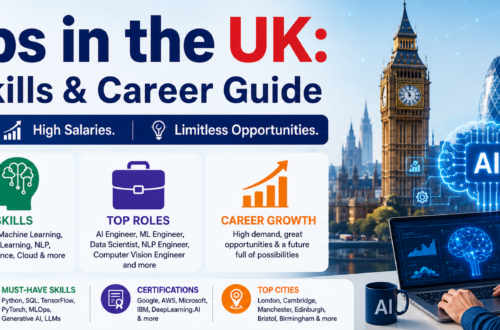
Artificial Intelligence Careers in the UK: Complete Career Guide, AI Jobs, Salaries & Future Opportunities
Artificial Intelligence (AI) is transforming every major industry across the United Kingdom. From healthcare and finance to cybersecurity, retail, education, manufacturing, and transportation, organizations are increasingly investing in AI-powered technologies to improve efficiency, automate repetitive tasks, and make data-driven decisions. This rapid digital transformation has created an unprecedented demand for skilled AI professionals throughout the UK.
Whether you’re a student considering a career in technology, a software developer looking to specialize in AI, or an experienced professional planning a career transition, Artificial Intelligence careers in the UK offer excellent salaries, long-term job security, and opportunities to work on innovative projects that shape the future.
According to industry reports, AI-related jobs continue to grow much faster than traditional IT roles. Companies are actively hiring professionals with expertise in machine learning, deep learning, natural language processing (NLP), computer vision, robotics, and generative AI technologies such as ChatGPT and Large Language Models (LLMs).
In this comprehensive guide, you’ll learn everything about AI careers in the UK, including:
- Highest-paying AI jobs
- AI salary ranges
- Essential technical and soft skills
- Educational qualifications
- Career roadmap
- Industries hiring AI professionals
- Future job opportunities
- Tips for getting hired
Whether you’re aiming to become an AI Engineer, Machine Learning Engineer, Data Scientist, Prompt Engineer, or AI Research Scientist, this guide will help you understand the opportunities available in the UK job market.
Why Artificial Intelligence Careers Are Booming in the UK
The UK has become one of Europe’s leading hubs for Artificial Intelligence innovation. Government investment, private sector funding, university research, and growing adoption of AI technologies have contributed to an expanding job market.
Several factors are driving this growth:
Digital Transformation
Businesses are rapidly adopting AI to automate processes, reduce costs, and improve customer experiences. Organizations across every sector are integrating AI into daily operations.
Government Support
The UK government continues investing in AI research, innovation, and digital infrastructure, encouraging companies to develop advanced AI solutions.
Increasing Demand for Automation
Organizations want to automate repetitive work using AI-powered software, creating demand for professionals who can build and manage intelligent systems.
Growth of Generative AI
Technologies like ChatGPT, Microsoft Copilot, Gemini, and Claude have accelerated the adoption of Generative AI across businesses.
AI Skills Shortage
Although demand is increasing rapidly, there remains a shortage of qualified AI professionals, leading to attractive salaries and strong career growth.
What Are Artificial Intelligence Careers?
Artificial Intelligence careers involve designing, developing, deploying, and maintaining intelligent computer systems capable of performing tasks that normally require human intelligence.
These tasks include:
- Learning from data
- Understanding human language
- Recognizing images
- Making predictions
- Automating decisions
- Generating content
- Detecting fraud
- Recommending products
- Building intelligent chatbots
- Optimizing business processes
AI professionals work with large datasets, machine learning algorithms, cloud computing platforms, programming languages, and advanced mathematical models.
Industries Hiring AI Professionals in the UK
Artificial Intelligence is no longer limited to technology companies. Almost every industry now requires AI specialists.
Banking & Financial Services
Banks use AI for:
- Fraud detection
- Credit scoring
- Risk management
- Trading algorithms
- Customer service chatbots
- Financial forecasting
Popular employers include:
- HSBC
- Barclays
- Lloyds Banking Group
- NatWest
- Revolut
Healthcare
Healthcare organizations use AI for:
- Disease prediction
- Medical imaging
- Drug discovery
- Clinical decision support
- Patient monitoring
- Virtual healthcare assistants
Retail & E-commerce
Retail companies apply AI for:
- Personalized recommendations
- Inventory forecasting
- Customer analytics
- Dynamic pricing
- Demand prediction
Manufacturing
Manufacturers use AI for:
- Predictive maintenance
- Robotics
- Quality inspection
- Supply chain optimization
- Production planning
Cybersecurity
AI is increasingly used to:
- Detect cyber attacks
- Identify malware
- Monitor suspicious activity
- Prevent data breaches
- Automate incident response
Automotive Industry
Self-driving technologies, smart vehicles, and autonomous systems require AI specialists with expertise in computer vision and deep learning.
Education
Educational institutions use AI to develop:
- Intelligent tutoring systems
- Personalized learning platforms
- Student performance analytics
- Automated assessments
Top Artificial Intelligence Careers in the UK
Below are some of the most in-demand AI career options.
1. AI Engineer
AI Engineers develop intelligent applications using machine learning, deep learning, and neural networks.
Responsibilities
- Build AI models
- Deploy machine learning solutions
- Train algorithms
- Optimize AI performance
- Integrate AI into applications
Skills
- Python
- TensorFlow
- PyTorch
- Machine Learning
- APIs
- Docker
- Cloud Computing
Average Salary:
£60,000–£95,000 annually
2. Machine Learning Engineer
Machine Learning Engineers create systems that automatically learn from data.
Responsibilities
- Develop ML pipelines
- Feature engineering
- Model optimization
- Production deployment
- Data preprocessing
Popular Tools
- Python
- Scikit-learn
- TensorFlow
- PyTorch
- MLflow
- Kubeflow
Average Salary
£65,000–£100,000
3. Data Scientist
Data Scientists analyze structured and unstructured data to discover business insights.
Daily tasks include:
- Data analysis
- Statistical modelling
- Machine learning
- Dashboard development
- Predictive analytics
Required Skills
- Python
- SQL
- Power BI
- Tableau
- Pandas
- NumPy
- Statistics
Average Salary
£55,000–£90,000
4. AI Research Scientist
Research Scientists work on advanced AI algorithms and cutting-edge technologies.
Common employers include:
- Universities
- AI laboratories
- Technology companies
- Research organizations
Required Education
Usually MSc or PhD in:
- Artificial Intelligence
- Computer Science
- Mathematics
- Machine Learning
Average Salary
£70,000–£120,000
5. NLP Engineer (Natural Language Processing)
NLP Engineers develop systems capable of understanding human language.
Examples include:
- Chatbots
- Voice assistants
- Translation software
- Search engines
- Sentiment analysis
Skills
- Python
- Transformers
- BERT
- GPT Models
- Hugging Face
- SpaCy
Average Salary
£65,000–£100,000
6. Computer Vision Engineer
Computer Vision Engineers build AI systems capable of interpreting images and videos.
Applications include:
- Facial recognition
- Autonomous vehicles
- Medical imaging
- Security surveillance
- Manufacturing inspection
Popular Technologies
- OpenCV
- YOLO
- TensorFlow
- PyTorch
- CNN
- Image Segmentation
Salary
£65,000–£105,000
7. Robotics Engineer
Robotics Engineers combine Artificial Intelligence with mechanical systems.
Industries
- Automotive
- Manufacturing
- Aerospace
- Healthcare
- Defence
Skills
- ROS
- Python
- Embedded Systems
- AI Algorithms
- Sensors
- Robotics
Average Salary
£55,000–£95,000
8. Generative AI Engineer
One of the fastest-growing careers in 2026.
Generative AI Engineers develop applications powered by Large Language Models.
Responsibilities include:
- AI chatbots
- Content generation
- AI assistants
- RAG applications
- AI automation
- Prompt optimization
Skills
- OpenAI APIs
- LangChain
- LlamaIndex
- Python
- Vector Databases
- Pinecone
- ChromaDB
Average Salary
£75,000–£130,000
9. Prompt Engineer
Prompt Engineering has emerged as a specialized career focused on designing effective prompts for Large Language Models (LLMs) to produce accurate and reliable outputs.
Key Responsibilities
- Design and optimize prompts
- Evaluate AI model responses
- Improve chatbot accuracy
- Develop prompt libraries
- Work closely with AI developers and business teams
Essential Skills
- Large Language Models (LLMs)
- Prompt Engineering
- GPT, Claude, Gemini
- Natural Language Processing
- Critical Thinking
- Python (preferred)
- AI Testing
Average Salary
£50,000–£90,000
10. MLOps Engineer
MLOps Engineers bridge the gap between machine learning development and production deployment, ensuring AI models are scalable, secure, and continuously monitored.
Responsibilities
- Deploy ML models to production
- Automate CI/CD pipelines
- Monitor model performance
- Manage model versioning
- Optimize cloud infrastructure
Common Tools
- Docker
- Kubernetes
- MLflow
- Kubeflow
- Jenkins
- GitHub Actions
- AWS SageMaker
- Azure ML
- Google Vertex AI
Average Salary
£70,000–£115,000
Artificial Intelligence is one of the fastest-growing career sectors in the UK, with opportunities across finance, healthcare, retail, manufacturing, cybersecurity, education, and technology. Roles such as AI Engineer, Machine Learning Engineer, Data Scientist, Generative AI Engineer, Prompt Engineer, and MLOps Engineer offer competitive salaries and strong long-term growth. As AI adoption accelerates, professionals with the right technical skills and practical experience are well positioned for rewarding careers.
Artificial Intelligence Salary in the UK (2026)
One of the biggest reasons professionals are switching to AI careers is the attractive salary potential. AI specialists are among the highest-paid professionals in the technology sector due to the growing demand and shortage of experienced talent.
Average AI Salary by Experience
| Experience | Average Salary |
|---|---|
| Fresher (0–1 Year) | £32,000–£45,000 |
| Junior (1–3 Years) | £45,000–£60,000 |
| Mid-Level (3–5 Years) | £60,000–£80,000 |
| Senior (5–8 Years) | £80,000–£110,000 |
| Lead AI Engineer | £100,000–£140,000 |
| AI Architect | £110,000–£160,000+ |
| AI Director / Head of AI | £140,000–£220,000+ |
AI Salary by Job Role
| Job Role | Average Annual Salary |
|---|---|
| AI Engineer | £60,000–£95,000 |
| Machine Learning Engineer | £65,000–£100,000 |
| Data Scientist | £55,000–£90,000 |
| Data Engineer | £55,000–£90,000 |
| NLP Engineer | £65,000–£100,000 |
| Computer Vision Engineer | £65,000–£105,000 |
| Generative AI Engineer | £75,000–£130,000 |
| Prompt Engineer | £50,000–£90,000 |
| AI Consultant | £70,000–£120,000 |
| AI Research Scientist | £70,000–£120,000 |
| MLOps Engineer | £70,000–£115,000 |
| AI Solution Architect | £100,000–£150,000 |
AI Salary by UK City
Salary levels vary based on location, company size, and industry.
| City | Typical Salary |
|---|---|
| London | £70,000–£130,000 |
| Cambridge | £65,000–£120,000 |
| Manchester | £55,000–£90,000 |
| Birmingham | £50,000–£85,000 |
| Edinburgh | £55,000–£95,000 |
| Bristol | £55,000–£90,000 |
| Leeds | £50,000–£85,000 |
| Glasgow | £48,000–£82,000 |
London generally offers the highest salaries, while cities like Manchester, Birmingham, and Leeds provide excellent opportunities with a lower cost of living.
Skills Required for Artificial Intelligence Careers
Employers seek professionals with a blend of technical expertise, analytical thinking, and communication skills.
Technical Skills
- Python Programming
- SQL
- Statistics
- Mathematics
- Machine Learning
- Deep Learning
- Neural Networks
- Natural Language Processing (NLP)
- Computer Vision
- Reinforcement Learning
- Data Structures & Algorithms
- Feature Engineering
- Data Visualization
- API Development
- Model Deployment
- Cloud Computing
- MLOps
- Git & GitHub
Programming Languages
Python remains the most important language for AI development.
Python
Most AI frameworks and libraries are built around Python.
Popular libraries include:
- NumPy
- Pandas
- Scikit-learn
- TensorFlow
- PyTorch
- Keras
- Hugging Face Transformers
- OpenCV
- SpaCy
SQL
AI professionals frequently work with structured data stored in relational databases.
Knowledge of:
- Joins
- Window Functions
- CTEs
- Stored Procedures
- Query Optimization
is highly valuable.
R
Often used in:
- Statistical analysis
- Academic research
- Predictive modelling
Java
Common in enterprise AI applications.
C++
Useful in robotics, gaming, autonomous vehicles, and performance-critical AI systems.
AI Frameworks You Should Learn
The following frameworks are widely used across the AI industry.
TensorFlow
- Google’s deep learning framework
- Production-ready
- Excellent for scalable AI systems
PyTorch
Preferred for:
- Research
- Generative AI
- Deep Learning
- Computer Vision
Scikit-learn
Ideal for:
- Classical Machine Learning
- Classification
- Regression
- Clustering
Hugging Face
Essential for:
- Transformers
- GPT Models
- BERT
- LLM Applications
LangChain
One of the most popular frameworks for developing AI applications powered by Large Language Models.
Used for:
- Chatbots
- AI Assistants
- RAG Applications
- AI Agents
Cloud Platforms for AI
Modern AI applications are heavily cloud-based.
Amazon Web Services (AWS)
Popular AI services:
- SageMaker
- Bedrock
- Lambda
- EC2
- S3
Microsoft Azure
Key AI offerings:
- Azure OpenAI
- Azure Machine Learning
- Cognitive Services
Google Cloud Platform (GCP)
Popular services include:
- Vertex AI
- BigQuery
- Cloud Storage
- AI APIs
Mathematics Required for AI
Strong mathematical foundations improve your understanding of machine learning algorithms.
Topics include:
- Linear Algebra
- Probability
- Statistics
- Calculus
- Matrix Operations
- Optimization
- Bayesian Theory
Soft Skills Employers Value
Technical knowledge alone isn’t enough.
Successful AI professionals also possess:
- Problem-solving ability
- Communication skills
- Team collaboration
- Business understanding
- Critical thinking
- Adaptability
- Creativity
- Leadership
- Time management
- Continuous learning mindset
Best Artificial Intelligence Certifications
Professional certifications can strengthen your CV and demonstrate practical expertise.
Beginner Level
- AI Fundamentals
- Python Programming
- SQL
- Machine Learning Basics
Intermediate Level
- TensorFlow Developer
- AWS Machine Learning
- Azure AI Engineer
- Google Cloud AI
Advanced Level
- Deep Learning Specialization
- Generative AI Engineering
- MLOps
- LLM Engineering
- AI Solution Architecture
Best Degrees for AI Careers
Most employers prefer candidates with degrees in:
- Computer Science
- Artificial Intelligence
- Data Science
- Software Engineering
- Mathematics
- Statistics
- Information Technology
- Robotics
- Electronics Engineering
However, many professionals successfully transition into AI through self-learning, online courses, certifications, and hands-on projects.
Top Universities in the UK for Artificial Intelligence
The UK is home to several globally recognized institutions offering AI-related programs and research opportunities.
- University of Oxford
- University of Cambridge
- Imperial College London
- University College London (UCL)
- University of Edinburgh
- University of Manchester
- King’s College London
- University of Bristol
- University of Warwick
- University of Southampton
Graduates from these universities are often recruited by leading technology companies, financial institutions, healthcare organizations, and AI startups.
Top Companies Hiring AI Professionals in the UK
AI talent is in demand across multinational corporations, technology firms, financial services, healthcare providers, and innovative startups.
Technology Companies
- Google DeepMind
- Microsoft
- Amazon
- IBM
- Oracle
- NVIDIA
- Meta
- Apple
Financial Services
- HSBC
- Barclays
- Lloyds Banking Group
- NatWest
- Revolut
Consulting Firms
- Accenture
- Deloitte
- PwC
- EY
- KPMG
Healthcare & Pharmaceuticals
- AstraZeneca
- GSK
- NHS Digital
- BenevolentAI
AI Startups
The UK’s startup ecosystem is rapidly growing, creating opportunities in:
- Generative AI
- Robotics
- Computer Vision
- Healthcare AI
- FinTech
- Cybersecurity
- Autonomous Systems
Artificial Intelligence Career Roadmap
If you’re wondering how to build a successful AI career, follow this structured roadmap.
Step 1: Learn Programming
Start with:
- Python
- SQL
- Git
Step 2: Learn Mathematics
Focus on:
- Probability
- Statistics
- Linear Algebra
- Calculus
Step 3: Master Data Analysis
Use:
- Pandas
- NumPy
- Matplotlib
- Power BI
Step 4: Learn Machine Learning
Study:
- Regression
- Classification
- Clustering
- Decision Trees
- Random Forest
- Support Vector Machines
Step 5: Learn Deep Learning
Topics include:
- Artificial Neural Networks
- CNNs
- RNNs
- LSTMs
- Transformers
Step 6: Learn Generative AI
Understand:
- Large Language Models (LLMs)
- Prompt Engineering
- Retrieval-Augmented Generation (RAG)
- AI Agents
- Vector Databases
- Fine-Tuning
Step 7: Build Real Projects
Create a portfolio with projects such as:
- AI Chatbot
- Resume Screening System
- Fraud Detection Model
- Recommendation Engine
- Image Classification
- Sentiment Analysis
- Voice Assistant
- AI Document Search using RAG
Step 8: Learn Cloud & Deployment
Gain practical experience with:
- Docker
- Kubernetes
- AWS
- Azure
- GCP
- CI/CD Pipelines
Step 9: Build Your Portfolio
Showcase your work on:
- GitHub
- Personal Website
- Kaggle
Include project documentation, code repositories, and demonstrations to impress recruiters.
Tips to Get Your First AI Job in the UK
- Master Python and SQL.
- Build a portfolio of real-world AI projects.
- Participate in Kaggle competitions.
- Contribute to open-source AI initiatives.
- Stay updated with the latest AI tools and frameworks.
- Tailor your CV to each AI role.
- Practice coding and machine learning interview questions.
- Network through LinkedIn, AI meetups, and conferences.
- Apply consistently for graduate schemes, internships, and entry-level AI roles.
Artificial Intelligence Interview Questions
Recruiters typically assess candidates in four key areas:
- Programming
- Machine Learning
- Deep Learning & Generative AI
- Problem Solving & Business Understanding
Below are some frequently asked interview questions.
Python Interview Questions
- What are Python decorators?
- Explain generators in Python.
- What is list comprehension?
- Difference between list, tuple, dictionary, and set?
- Explain multithreading and multiprocessing.
- What are lambda functions?
- What are Python packages and virtual environments?
- Explain object-oriented programming concepts.
- How does memory management work in Python?
- What is the Global Interpreter Lock (GIL)?
Machine Learning Interview Questions
- What is Machine Learning?
- Types of Machine Learning.
- Difference between supervised and unsupervised learning.
- Explain overfitting and underfitting.
- What is cross-validation?
- What is feature engineering?
- Explain precision and recall.
- What is the F1 Score?
- What are decision trees?
- Explain Random Forest.
- What is XGBoost?
- What is gradient descent?
- Difference between bagging and boosting.
Deep Learning Questions
- What are neural networks?
- Explain backpropagation.
- What is an activation function?
- What are CNNs?
- Explain RNNs.
- What are LSTMs?
- What are Transformers?
- Explain attention mechanisms.
- What is transfer learning?
- What is fine-tuning?
Generative AI Questions
These are among the most frequently asked in 2026.
- What is Generative AI?
- Explain Large Language Models.
- What is Prompt Engineering?
- What is Retrieval-Augmented Generation (RAG)?
- Explain embeddings.
- What are vector databases?
- What is LangChain?
- What is LlamaIndex?
- Difference between GPT and BERT.
- What is fine-tuning?
- What is tokenization?
- Explain hallucination in AI.
- How do you reduce hallucinations?
- What is model context window?
- Explain AI agents.
SQL Interview Questions
- Difference between WHERE and HAVING.
- Explain joins.
- What are indexes?
- Difference between DELETE, DROP, and TRUNCATE.
- What are CTEs?
- Explain window functions.
- What is normalization?
- Difference between clustered and non-clustered indexes.
- Write SQL to find duplicate records.
- Explain stored procedures.
HR Interview Questions
- Tell us about yourself.
- Why do you want to work in AI?
- Describe your most challenging project.
- How do you stay updated with AI technologies?
- Why should we hire you?
- Where do you see yourself in five years?
- Describe a time you solved a difficult technical problem.
- How do you manage deadlines?
- Explain a project to a non-technical audience.
- What motivates you?
How to Build an AI Resume
A strong AI resume should demonstrate both technical expertise and practical experience.
Include These Sections
Professional Summary
Highlight your years of experience, AI specialization, and key achievements.
Example:
“Artificial Intelligence Engineer with 5+ years of experience designing machine learning solutions, Generative AI applications, and cloud-based AI platforms using Python, TensorFlow, AWS, and Large Language Models.”
Technical Skills
Include relevant skills such as:
- Python
- SQL
- TensorFlow
- PyTorch
- Machine Learning
- Deep Learning
- NLP
- Computer Vision
- AWS
- Azure
- Docker
- Kubernetes
- LangChain
- Hugging Face
- Git
Projects
Recruiters value real-world AI projects.
Examples include:
- Resume Screening AI
- AI Chatbot
- Recommendation System
- Fraud Detection Model
- Medical Image Classification
- Customer Churn Prediction
- Sentiment Analysis
- RAG-based Knowledge Assistant
- Predictive Maintenance System
- AI Document Summarizer
Describe the problem, technologies used, your role, and measurable outcomes wherever possible.
Certifications
Mention recognized certifications in:
- AWS
- Azure
- Google Cloud
- TensorFlow
- Machine Learning
- Generative AI
Remote Artificial Intelligence Jobs in the UK
Remote work has become a standard option for many AI professionals. Organizations increasingly hire talent from across the UK, allowing engineers and data scientists to collaborate with global teams.
Popular remote AI roles include:
- AI Engineer
- Machine Learning Engineer
- Data Scientist
- Prompt Engineer
- NLP Engineer
- Computer Vision Engineer
- AI Consultant
- MLOps Engineer
- Data Engineer
- AI Product Manager
Benefits of remote AI careers include:
- Flexible work schedules
- Access to global employers
- Better work-life balance
- Reduced commuting costs
- Opportunities to work on international projects
Freelancing in Artificial Intelligence
Beyond full-time employment, AI professionals can generate income through freelance and consulting work.
Popular freelance AI services include:
- Chatbot development
- AI automation for businesses
- Machine learning model development
- Data analytics
- AI consulting
- Prompt engineering
- Computer vision applications
- NLP solutions
- AI integration with existing software
- Predictive analytics
A strong portfolio and client testimonials can significantly improve freelance opportunities.
Future of Artificial Intelligence Careers
The demand for AI professionals is expected to continue growing over the next decade. Organizations are investing heavily in intelligent systems to improve productivity, customer experience, and innovation.
Emerging areas include:
- Generative AI
- AI Agents
- Autonomous Systems
- Robotics
- Explainable AI (XAI)
- Responsible AI
- AI Governance
- Edge AI
- AI for Healthcare
- AI for Climate and Sustainability
- AI in Financial Services
- AI-powered Cybersecurity
Professionals who continuously learn and adapt to new technologies are likely to benefit from strong career prospects.
Common Mistakes to Avoid
Many aspiring AI professionals delay their growth by making avoidable mistakes.
Avoid the following:
- Learning too many technologies without mastering the fundamentals.
- Ignoring mathematics and statistics.
- Building only tutorial-based projects.
- Not using version control (Git).
- Skipping cloud deployment knowledge.
- Neglecting communication and presentation skills.
- Failing to document projects.
- Applying with a generic resume for every role.
- Ignoring interview preparation.
- Not keeping up with evolving AI frameworks.
Career Progression in Artificial Intelligence
A typical AI career path may look like this:
- AI Intern
- Junior AI Engineer
- Machine Learning Engineer
- Senior AI Engineer
- Lead AI Engineer
- AI Solution Architect
- AI Engineering Manager
- Head of Artificial Intelligence
- Director of AI
- Chief AI Officer
Career progression depends on technical expertise, leadership skills, business understanding, and continuous learning.
Frequently Asked Questions (FAQ)
1. Is Artificial Intelligence a good career in the UK?
Yes. AI offers excellent salaries, strong demand, and opportunities across multiple industries.
2. Which AI job pays the highest?
AI Architects, AI Directors, and experienced Generative AI Engineers are among the highest-paid AI professionals.
3. Can I get an AI job without a degree?
Some employers value practical skills, certifications, and project portfolios. However, many roles still prefer a relevant degree, especially for research-focused positions.
4. Is Python mandatory for AI?
Python is the most widely used programming language in AI and is highly recommended.
5. Which AI field has the highest demand?
Generative AI, Machine Learning, NLP, Computer Vision, MLOps, and AI Security are currently among the fastest-growing fields.
6. Is AI replacing software developers?
AI is changing how software is developed by automating some tasks, but it is also creating new roles. Developers who learn AI tools and techniques are likely to remain in strong demand.
7. How long does it take to learn AI?
The timeline varies. With consistent study, foundational AI skills can often be developed in several months, while advanced expertise usually takes longer and requires hands-on experience.
8. Which industries hire AI professionals?
Finance, healthcare, retail, manufacturing, education, cybersecurity, automotive, logistics, telecommunications, and government organizations all hire AI professionals.
9. Can fresh graduates start an AI career?
Yes. Graduates with strong programming skills, AI projects, internships, and relevant certifications can compete for entry-level AI roles.
10. What programming language should I learn first?
Python is generally the best starting point due to its extensive AI ecosystem.
11. Is mathematics important in AI?
Yes. Concepts such as statistics, probability, linear algebra, and optimization underpin many machine learning algorithms.
12. Do AI professionals need cloud computing skills?
Cloud knowledge is increasingly valuable because many AI models are trained, deployed, and managed on cloud platforms.
13. What is the difference between AI and Machine Learning?
Artificial Intelligence is the broader field focused on creating intelligent systems. Machine Learning is a subset of AI that enables systems to learn from data.
14. Are AI certifications worth it?
Certifications can strengthen your profile, especially when combined with practical projects and work experience.
15. Can I switch from software development to AI?
Yes. Many software engineers transition into AI by learning machine learning, data science, and modern AI frameworks.
16. Is Generative AI a good career choice?
Generative AI is one of the fastest-growing areas in technology, with opportunities in content generation, automation, customer support, software development, and enterprise AI solutions.
17. What are employers looking for in AI candidates?
Strong programming skills, practical project experience, cloud knowledge, problem-solving ability, communication skills, and familiarity with modern AI frameworks.
18. How can I stand out in AI job applications?
Create original projects, contribute to open-source initiatives, maintain an active GitHub profile, tailor your resume, and prepare thoroughly for interviews.
Artificial Intelligence Careers in the UK
Artificial Intelligence is reshaping industries across the United Kingdom, making it one of the most promising career paths for students, graduates, and experienced professionals alike. From machine learning and natural language processing to generative AI and autonomous systems, the opportunities continue to expand as organizations adopt AI-driven solutions.
Success in this field requires a combination of technical knowledge, practical experience, continuous learning, and adaptability. Building a strong foundation in programming, mathematics, machine learning, cloud computing, and modern AI frameworks—while developing a portfolio of real-world projects—can significantly improve your employability.
Whether you’re starting your first AI course, transitioning from another technology role, or aiming for a senior leadership position, investing in AI skills today can open the door to a rewarding and future-focused career.