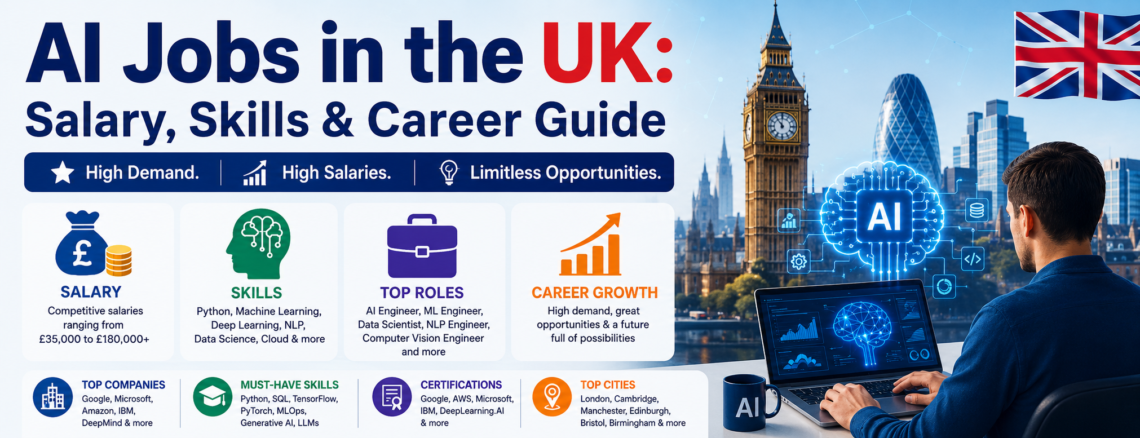
Artificial Intelligence (AI) is transforming every industry across the United Kingdom. From healthcare and finance to retail, cybersecurity, manufacturing, education, and autonomous systems, organizations are investing heavily in AI technologies to automate processes, improve decision-making, and create innovative products.
As a result, AI jobs in the UK are among the highest-paying and fastest-growing career opportunities in 2026. Whether you’re a recent graduate, software developer, data analyst, or experienced engineer looking to transition into AI, this guide covers everything you need to know.
In this comprehensive article, you’ll learn about:
- AI job opportunities in the UK
- Average AI salaries
- Required technical and soft skills
- Best programming languages
- Career roadmap
- Top companies hiring AI professionals
- Certifications
- Future trends
- Frequently Asked Questions
Why AI Careers Are Growing in the UK
The UK government and private organizations continue investing billions into Artificial Intelligence research and innovation.
Industries rapidly adopting AI include:
- Banking
- Healthcare
- Insurance
- Retail
- Manufacturing
- Cybersecurity
- Autonomous Vehicles
- Education
- Government Services
- Telecommunications
- Pharmaceuticals
- Logistics
- FinTech
AI is now powering:
- Virtual Assistants
- Fraud Detection
- Chatbots
- Medical Diagnosis
- Recommendation Systems
- Predictive Analytics
- Computer Vision
- Voice Recognition
- Robotics
- Large Language Models (LLMs)
This demand has created thousands of AI job openings throughout London, Manchester, Birmingham, Edinburgh, Leeds, Bristol, Cambridge, and other UK cities.
What Does an AI Engineer Do?
An Artificial Intelligence Engineer designs intelligent systems that can learn, reason, predict, and automate tasks.
Typical responsibilities include:
- Building Machine Learning models
- Training Deep Learning networks
- Developing AI-powered applications
- Processing large datasets
- Optimizing AI algorithms
- Deploying ML models
- Working with cloud AI platforms
- Building recommendation engines
- Developing chatbots
- Implementing Large Language Models (LLMs)
- Creating Generative AI applications
- Monitoring AI model performance
Most Popular AI Jobs in the UK
The AI industry offers various specialized career paths.
1. AI Engineer
Average Salary:
£55,000 – £95,000 per year
Skills:
- Python
- TensorFlow
- PyTorch
- Machine Learning
- APIs
- Cloud Platforms
2. Machine Learning Engineer
Salary:
£60,000 – £100,000
Responsibilities:
- Model training
- Feature engineering
- Data pipelines
- Model deployment
- Performance optimization
3. Data Scientist
Salary:
£50,000 – £90,000
Skills:
- Statistics
- SQL
- Python
- Data Visualization
- Machine Learning
- Predictive Analytics
4. NLP Engineer
Natural Language Processing specialists work on:
- ChatGPT-like applications
- Text classification
- Language translation
- Sentiment analysis
- Voice assistants
Average salary:
£65,000 – £110,000
5. Computer Vision Engineer
Develops systems capable of understanding images and videos.
Applications include:
- CCTV analytics
- Facial recognition
- Medical imaging
- Autonomous driving
Salary:
£60,000 – £105,000
6. AI Research Scientist
Works on cutting-edge AI algorithms.
Usually requires:
- MSc
- PhD
- Strong mathematics background
Salary:
£75,000 – £140,000
7. Prompt Engineer
One of the newest AI careers.
Responsibilities:
- Prompt optimization
- LLM tuning
- AI workflow design
- Chatbot optimization
Salary:
£55,000 – £100,000
8. Generative AI Engineer
Develops applications using:
- GPT models
- Claude
- Gemini
- Stable Diffusion
- AI Agents
- Retrieval-Augmented Generation (RAG)
Salary:
£70,000 – £130,000
AI Job Salary in the UK
| Experience | Average Salary |
|---|---|
| Fresher | £35,000–£50,000 |
| 2 Years | £45,000–£60,000 |
| 3–5 Years | £60,000–£85,000 |
| 5–8 Years | £80,000–£110,000 |
| Senior AI Engineer | £100,000–£140,000 |
| AI Architect | £120,000–£180,000+ |
Salaries vary based on location, industry, company size, and specialized skills.
Highest Paying AI Skills
Professionals with expertise in the following technologies often command premium salaries:
- Machine Learning
- Deep Learning
- Generative AI
- Large Language Models (LLMs)
- Python
- PyTorch
- TensorFlow
- Computer Vision
- Natural Language Processing
- Reinforcement Learning
- MLOps
- Kubernetes
- Docker
- AWS AI Services
- Azure AI
- Google Cloud AI
- Vector Databases
- LangChain
- RAG
- AI Agents
Technical Skills Required
Employers frequently seek candidates with knowledge of:
Programming Languages
- Python
- Java
- C++
- R
- SQL
- JavaScript
Machine Learning
- Regression
- Classification
- Clustering
- Neural Networks
- Decision Trees
- Random Forest
- Gradient Boosting
Deep Learning
- CNN
- RNN
- Transformers
- LSTM
- GANs
Libraries
- TensorFlow
- PyTorch
- Scikit-learn
- Keras
- NumPy
- Pandas
- Matplotlib
- OpenCV
Data Engineering
- SQL
- Spark
- Hadoop
- Kafka
- Airflow
Cloud Platforms
- AWS
- Azure
- Google Cloud Platform
DevOps
- Docker
- Kubernetes
- Git
- Jenkins
- CI/CD
Essential Soft Skills
Technical expertise alone is not enough.
Employers also value:
- Problem-solving
- Critical thinking
- Communication
- Team collaboration
- Business understanding
- Creativity
- Adaptability
- Leadership
- Time management
- Presentation skills
Educational Qualifications
Common educational backgrounds include:
- Computer Science
- Artificial Intelligence
- Data Science
- Mathematics
- Statistics
- Software Engineering
- Information Technology
Many employers also accept candidates with practical AI experience and strong project portfolios.
Best AI Certifications
Popular certifications include:
- Google Professional Machine Learning Engineer
- Microsoft Azure AI Engineer Associate
- AWS Certified Machine Learning – Specialty
- IBM AI Engineering Professional Certificate
- DeepLearning.AI Machine Learning Specialization
- TensorFlow Developer Certificate
- NVIDIA Deep Learning Institute Courses
- Databricks Machine Learning Certification
AI Career Roadmap
Step 1
Learn Python.
Step 2
Master:
- SQL
- Statistics
- Linear Algebra
- Probability
Step 3
Study Machine Learning algorithms.
Step 4
Learn Deep Learning.
Step 5
Build AI projects.
Examples:
- Chatbot
- Image Classifier
- Resume Screening System
- Fraud Detection
- Recommendation Engine
Step 6
Learn Cloud Deployment.
Step 7
Master Generative AI.
Topics include:
- LLMs
- Prompt Engineering
- RAG
- LangChain
- AI Agents
- Vector Databases
Step 8
Create an impressive GitHub portfolio.
Step 9
Prepare for AI interviews.
Step 10
Apply for AI jobs in the UK.
Top Industries Hiring AI Professionals
The strongest demand comes from:
- Banking
- FinTech
- Healthcare
- Insurance
- Retail
- E-commerce
- Manufacturing
- Automotive
- Government
- Defence
- Cybersecurity
- Telecommunications
- Logistics
- Pharmaceuticals
- Energy
Best Cities for AI Jobs in the UK
The UK has several thriving AI hubs:
London
The largest AI job market, home to major technology firms, financial institutions, startups, and global consulting companies.
Cambridge
Renowned for AI research, innovation, and technology startups.
Manchester
A rapidly expanding technology hub with opportunities in software engineering and AI.
Edinburgh
Known for universities, AI research, robotics, and data science.
Bristol
Strong demand in aerospace, robotics, and embedded AI.
Birmingham
Growing investments in AI, manufacturing, and enterprise software.
Leeds
Increasing adoption of AI in healthcare, finance, and digital services.
Industries Using Generative AI
Generative AI is reshaping many sectors by enabling smarter automation and content creation.
- Marketing
- Customer Support
- Finance
- Healthcare
- Legal Services
- Education
- Recruitment
- Human Resources
- Software Development
- Sales
- Insurance
- Manufacturing
Professionals skilled in Generative AI, LLMs, and AI agents are expected to remain in high demand.
AI Interview Tips
To improve your chances of success:
- Build real-world AI projects and maintain a GitHub portfolio.
- Understand machine learning fundamentals rather than memorizing algorithms.
- Practice Python coding regularly.
- Revise statistics and probability concepts.
- Learn system design for AI applications.
- Gain familiarity with cloud deployment and MLOps.
- Stay informed about the latest advancements in Generative AI and LLMs.
- Prepare to explain your projects clearly, including business impact and technical decisions.
Future of AI Jobs in the UK
Artificial Intelligence will continue transforming the UK employment landscape over the next decade. While automation may replace some repetitive tasks, it is expected to create many new roles in AI development, governance, ethics, security, and operations.
Emerging specializations include:
- AI Governance
- AI Ethics
- AI Security
- MLOps
- AI Product Management
- Autonomous Systems
- AI Agent Development
- Multimodal AI
- Robotics Engineering
- Explainable AI (XAI)
Professionals who continuously upgrade their skills and adapt to new technologies will be well positioned for long-term career growth.
Frequently Asked Questions
Is AI a good career in the UK?
Yes. AI is one of the fastest-growing technology fields, offering excellent salaries, diverse career paths, and strong demand across multiple industries.
Which programming language is best for AI?
Python remains the most widely used language due to its extensive ecosystem of AI and machine learning libraries.
Can freshers get AI jobs?
Yes. Graduates with strong fundamentals, practical projects, internships, and relevant certifications can secure entry-level AI roles.
Which AI skill pays the highest?
Generative AI, Large Language Models (LLMs), MLOps, AI architecture, and AI research are among the highest-paying specializations.
Do AI jobs require a degree?
A degree in computer science, data science, mathematics, or a related field is beneficial, but many employers also value practical experience, portfolios, and certifications.
AI job opportunities in the UK
Artificial Intelligence is no longer a niche field—it is a core driver of innovation across the UK economy. Whether you’re aiming to become an AI Engineer, Machine Learning Engineer, Data Scientist, or Generative AI Specialist, now is an excellent time to build the required skills and enter this rapidly expanding profession.
Focus on mastering Python, machine learning, cloud technologies, and Generative AI while building a portfolio of practical projects. Combined with strong problem-solving abilities and continuous learning, these skills can help you secure rewarding AI jobs in the UK with competitive salaries and long-term career growth.
AI Jobs UK, Artificial Intelligence Jobs UK, AI Engineer Jobs UK, Machine Learning Jobs UK, AI Salary UK, Data Scientist Jobs UK, Generative AI Jobs UK, LLM Jobs UK, AI Careers UK, AI Engineer Salary UK, AI Skills UK, Artificial Intelligence Career Guide, AI Recruitment UK, AI Developer Jobs UK, AI Interview Questions, AI Engineer Career Path, AI Certification UK, Prompt Engineer Jobs UK, AI Jobs London, AI Jobs Manchester, AI Jobs Birmingham, AI Jobs Cambridge, AI Jobs Edinburgh, AI Jobs Leeds, AI Jobs Bristol.